
Sports Watch Market in 2026: What Is Holding Value
Divers, chronographs, and GMT watches are all trading differently in 2026. The market has cooled from the peak speculation years, but not all segments cooled equally — and the reasons tell you something useful if you are buying right now.
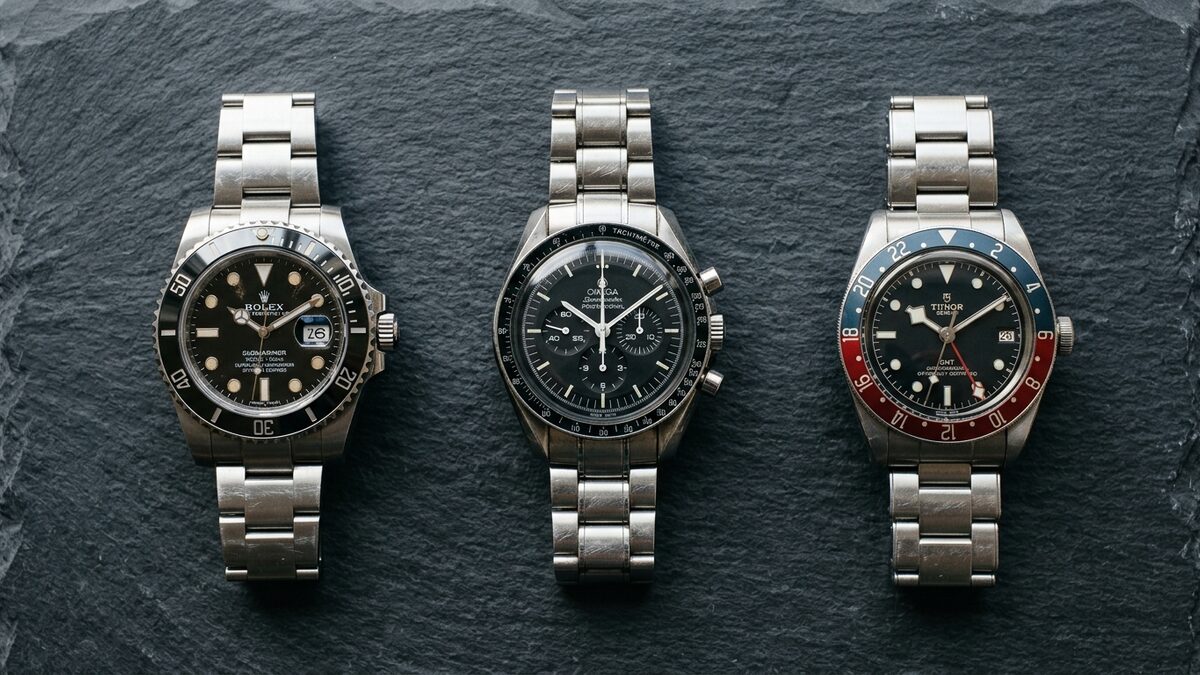
What "Sports Watch" Actually Means in the Pre-Owned Market
The category is broader than it sounds. In pre-owned trading, "sports watch" generally means any watch with a functional complication tied to an activity — a rotating bezel for dive time, a chronograph for elapsed measurement, a GMT hand for tracking a second time zone. What unites them is that the complication justifies a rugged case, a signed crown, and a movement built to handle more than a formal dinner.
That definition matters for valuation. A sports watch in good mechanical condition holds value better than a dress watch in comparable condition, partly because buyers expect some case wear and partly because the movement architecture tends to be more serviceable. But within the sports category, 2026 has produced meaningfully different demand curves for different complication types.
The Diver Segment: Depth Ratings Do Not Drive Value
Diving watches are the most liquid segment of the pre-owned sports market, but buyers have become sharper about what they are actually paying for. A 300-metre water resistance rating no longer commands a premium over a 200-metre rating on an equivalent reference — the realistic use case for either is the same, and the market has absorbed that.
What does move diver prices in 2026:
- Lume condition. Tritium dials with consistent patina hold better than refinished dials, even when the refinish is factory quality. The patina is a documentation of age, not a defect.
- Bezel insert integrity. Cracked or faded inserts push price down sharply. Replaced inserts with correct-era markers hold near original value; aftermarket inserts do not.
- Bracelet availability. Divers without their original bracelet trade at a consistent discount, even when the watch is otherwise complete. Sourcing a correct-reference bracelet costs more in time than money — buyers price that in.
The broad lesson for divers: condition on the parts that cannot be invisibly replaced is what drives the spread between retail and below-market pricing in this segment.
Chronographs: Movements Matter More Than Cases
Chronograph demand has bifurcated. Column-wheel movements — particularly those with lateral clutch mechanisms — continue to trade at a premium over cam-actuated equivalents. Buyers who understand movements have grown as a share of the market, and the column-wheel premium has actually widened slightly from 2024 to 2026 as information has become more accessible.
On the case side, pushers are the most common failure point on pre-owned chronographs and should be tested before purchase. A sticky or misaligned pusher is repairable, but the cost gets priced into the offer. If you are evaluating a chronograph in-person, cycle the start, stop, and reset functions several times. Hesitation in the reset return or a pusher that travels further than its counterpart are both signs of a worn column wheel or worn cam, depending on the architecture.
What is not moving chronograph prices much in 2026: case metal. The steel-versus-gold premium that was pronounced in 2021 and 2022 has compressed. Steel references have held value; gold references have softened to meet them. The gap is narrower than at any point in the past decade for the mainstream chronograph references.
GMT Complications: The Everyday-Carry Premium
GMT watches have benefited from a demographic shift. Remote work and distributed teams have made a secondary time zone practically useful for a wider buyer base, and that utility has translated into price support. The segment has not returned to 2021 peak premiums, but it has stabilized above 2019 levels in real terms for most mainstream references.
The distinction between a true GMT (independently settable 24-hour hand) and a GMT-style watch (24-hour hand that tracks with the hour hand) matters more to buyers now than it did five years ago. Listings that specify "true GMT" trade faster and at a modest premium. If you own one and are preparing to sell, that specification belongs in your headline.
Bezel legibility is the condition factor that matters most for GMTs. A scratched bezel on a diver is aesthetically acceptable to many buyers. A worn or partially illegible 24-hour scale on a GMT undermines the functionality of the complication — and buyers treat that differently.
What Is Not Holding Value in 2026
A few patterns have been consistent across the market this year:
- Polished cases on sports references. A sports watch that has been sent out for case polishing trades below an equivalent unpolished example in comparable grades. This was true before 2026 and has not changed.
- Non-original dials on otherwise complete watches. The refinished dial discount has grown. Buyers with access to authentication tools have made this a harder pass than it was even three years ago.
- Complete sets with non-matching paperwork. Box and papers where the serial does not match the watch, or where the papers are for a different reference year, now draw more scrutiny than they did at peak market. A "complete set" that cannot be verified is treated as no-papers by serious buyers.
- Sports references above $10K without service documentation. At lower price points buyers will absorb unknown service history. Above that threshold, the expectation of recent service records has hardened.
What to Do With This If You Are Buying Now
A steady or slightly softening market is, counterintuitively, a better buying environment than a rising one — provided you know what you are looking for. The premium for a clean, documented example has not evaporated; it has become more concentrated in the pieces that actually meet the criteria.
Three practical takeaways for a 2026 purchase:
- Buy condition, not story. A watch with a service record, intact lume, original bracelet, and a matching case is worth more than the same reference at a lower price with two of those missing. The math works out.
- Prioritize movement documentation over case cosmetics. You can live with a case scratch. You cannot live with an undisclosed movement issue that surfaces six months in. Ask for timing machine results before finalizing anything above $3,000.
- Verify the warranty before it matters. A MyEssentialSwiss warranty certificate attached to your purchase is underwritten against movement defects for two years. Read what it covers — and what it does not — before you need to file a claim rather than after.
Every watch sold through a MyEssentialSwiss authorized dealer includes a 2-year warranty certificate covering movement defects, parts, and labor. Questions about coverage for a specific reference? Email [email protected].