
What a Date Wheel Reveals About Originality
The date window is the smallest stage on a dial, yet it holds a surprising amount of evidence. On a pre-owned watch, the way a single numeral is printed, the shade of the disc behind it, and the precise centering of the digit can quietly settle the question of whether the dial in front of you is the one that left the factory.
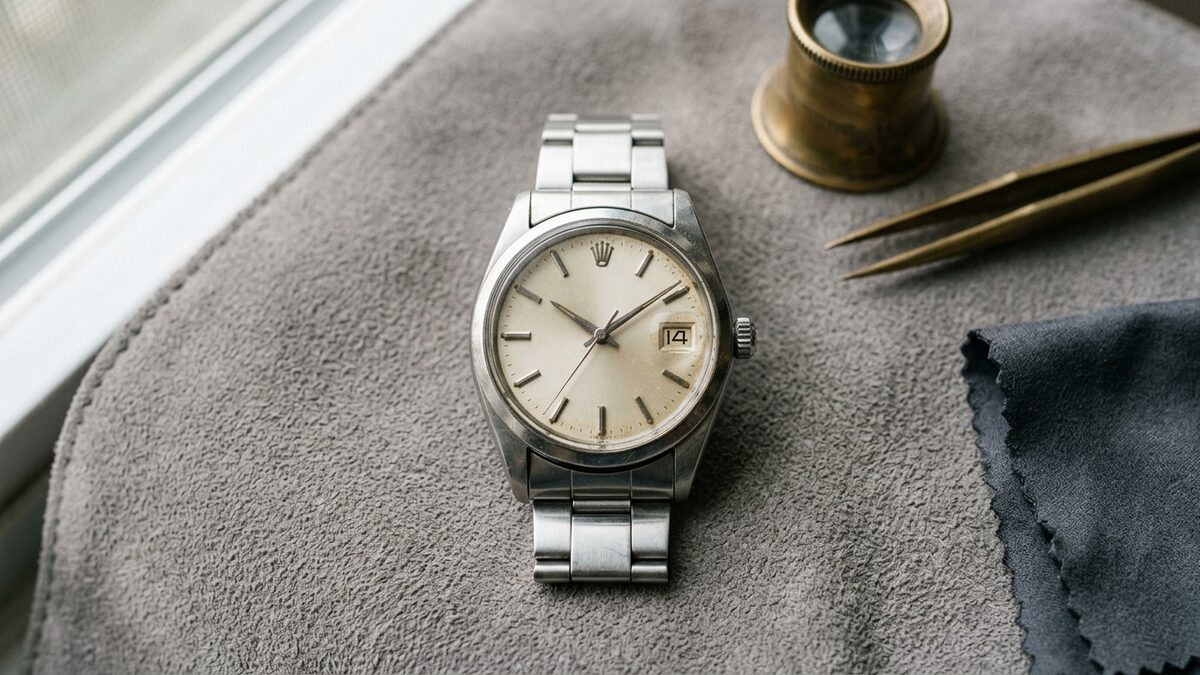
A date wheel is easy to overlook because it does exactly what it is asked to do, day after day, without drawing attention. That reliability is precisely why it rewards close reading. The disc is a factory-matched component, printed to a specification that changed slowly and deliberately over a caliber's production life. When a dial has been replaced, a movement swapped, or a date disc fitted during service, the mismatch often survives in a detail too small to fake convincingly.
Reading the font before you read the watch
The typeface is the first thing to study, and it is best studied cold, before expectation sets in. Manufacturers used specific numeral shapes for specific references and eras, and those shapes carry consistent proportions: the weight of a stroke, the openness of a six or a nine, the way a four closes or stays open at the top. A disc from a later service era may carry numerals that are technically correct for the brand yet wrong for the reference, printed a fraction bolder or set on a slightly different baseline.
It helps to know which changes were normal and which were not. Some references carried more than one legitimate disc over their run, so a small variation in numeral style is not proof of anything on its own. The task is to place the disc in its correct window of production and ask whether the rest of the watch agrees with that placement. A disc that belongs to a decade the dial predates, or one printed in a style the brand had already retired, is the kind of quiet contradiction that deserves attention.
Comparison is more useful than memory here. Place the digit against a known-original example of the same reference from the same period and look for agreement in three things: stroke weight, digit height, and the spacing between the tens and units column. A replaced disc frequently betrays itself in one of these before the others. The eye notices that a numeral sits a hair too high in the aperture, or that the ink looks flatter and more even than the slightly granular printing of the original era.
Color of the disc matters as much as the figures on it. A white disc that reads faintly cool against a warm, aged dial, or a black disc whose finish is glossier than the surrounding surface, suggests two components that did not age together. Patina is honest in this respect: original parts tend to travel through decades in step, while a replacement arrives fresh and stays a step behind.
What alignment and fit tell you about originality
Alignment is the quiet second witness. On a correctly fitted date, the numeral centers cleanly in its window, framed with even margins on all four sides. Persistent drift, a digit that rides high or leans toward one edge across several dates, can indicate a disc that was never meant for that dial's aperture, or a movement married to a case and dial it did not begin with. A single off-center date proves nothing; a pattern across the calendar is worth weighing.
A swapped movement leaves related traces worth chasing. When a caliber is replaced, the new date mechanism may sit at a fractionally different height, pushing the disc closer to or further from the dial and changing how sharply the numeral reads through the crystal's magnification. Look at how the digit fills the aperture and whether its plane matches the dial's. A date that seems to float or one that appears slightly sunk can be the visible edge of a change made underneath, where the collector cannot see directly.
The snap of the change is a further clue for those able to observe it. Original date mechanisms tend to flip crisply at a consistent hour, and a lazy or drifting change can point to a service movement or a disc fitted to a caliber it was not calibrated against. None of these observations stands alone. A watch that has lived a long life may carry a service dial or a replaced disc entirely legitimately, documented and disclosed, and that history is part of the object rather than a flaw in it.
Provenance closes the loop that the eye opens. Once the visual evidence raises a question, service records, an original warranty card, or a history from a trusted specialist can confirm whether a replaced disc or dial was fitted by an authorized workshop or by someone hoping the difference would go unnoticed. The most reassuring pre-owned watches are not always the most pristine; they are the ones whose small inconsistencies are explained rather than hidden. A frank account of a service dial is worth more than a suspiciously perfect surface with no story attached.
What a collector is really assessing is coherence. Do the font, the disc color, the aperture fit, and the general condition of the dial tell one consistent story, or do they argue with each other? A pre-owned piece whose date wheel agrees with its dial, whose dial agrees with its caliber, and whose caliber suits its case presents a whole that is difficult to assemble by accident. Discrepancy is not automatically dishonesty, but it is an invitation to ask better questions and to seek the paperwork that explains the gap.
Reading a date wheel well takes practice and, ideally, a loupe and reference images to hand. The reward is a habit of looking that extends to the rest of the watch: once the eye is trained to notice that a single numeral sits wrong, it stops taking the larger surfaces for granted. Originality, in the end, is a question answered detail by detail, and the date window is one of the most honest places to begin.