
Reading the Crystal: Acrylic, Mineral and Sapphire on a Pre-Owned Watch
The crystal is the first thing your eye meets and the last thing most buyers actually examine. On a pre-owned watch it is more than a window over the dial; it is a small record of when the object was made, how it has been treated, and whether the piece in front of you still matches the piece it left the factory as. Learning to read it is one of the quieter skills in evaluating a used watch, and one of the more reliable.
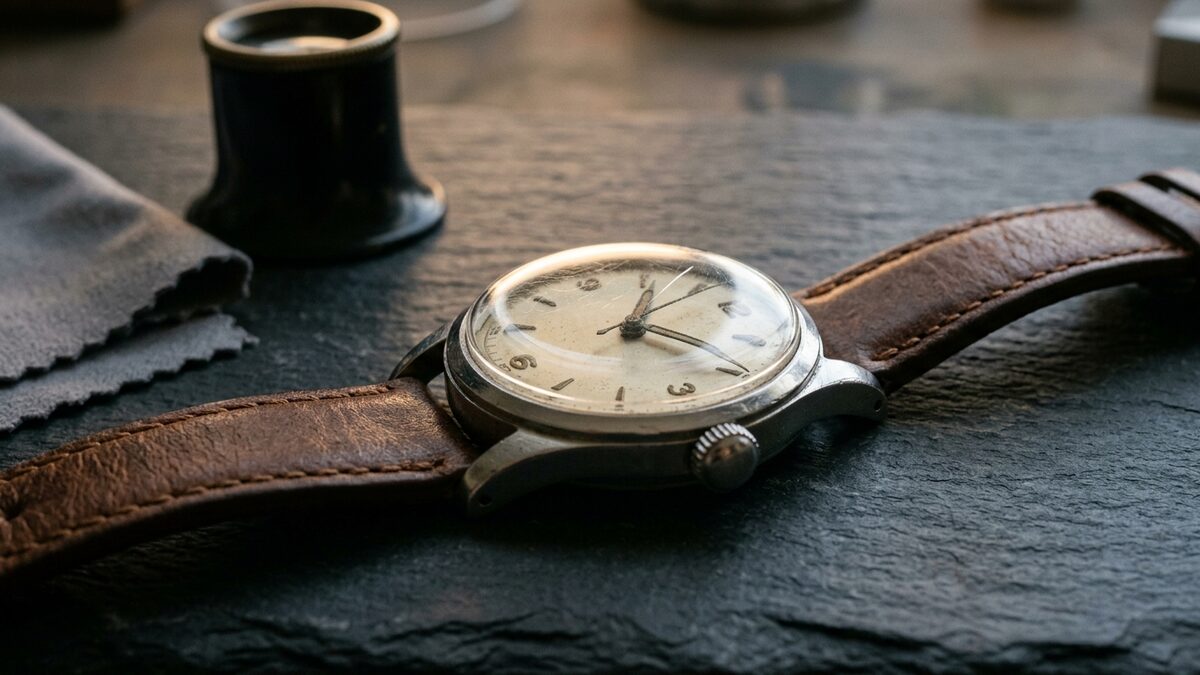
There are three materials you will meet in practice, and each carries its own character. Acrylic, sometimes called Plexiglas or hesalite, dominated the mid-twentieth century. It is warm to look at, slightly soft, and it domes beautifully. Mineral glass arrived as a harder, cheaper alternative and still appears on a great many pieces from the 1980s onward. Sapphire, synthetic and second only to diamond in hardness, became the reference material for higher-tier watches and is now near-universal at the top of the market. Knowing which one sits over the dial tells you a good deal before you have looked at anything else.
The quickest field test is behavior rather than appearance. Tap the crystal gently against a fingernail or a tooth: acrylic gives a soft, dull note, while mineral and sapphire ring harder and brighter. Breathe on the surface and watch how the condensation clears; sapphire sheds it fast and cool. Acrylic scratches if you look at it sternly, so a crystal covered in fine swirls and one deep gouge is almost certainly acrylic and almost certainly original to an older case. Sapphire resists scratches but can chip at the edge under a sharp knock, leaving a small conchoidal flake rather than a scuff.
What the Crystal Says About Age and Originality
Material and period should agree with one another. A 1960s dive watch wearing a flawless, perfectly flat crystal with a faint blue anti-reflective bloom is telling you something: it has almost certainly been re-crystalled, and possibly upgraded to sapphire at a later service. That is not a fault in itself. It is common, honest maintenance. But it is information, and it should shift how you read the rest of the watch. If the crystal has been changed, ask what else was touched at the same time.
Domed acrylic is often part of a watch's original silhouette, and replacing it with a flat modern crystal quietly alters the way light moves across the dial. Collectors who care about correctness will pay attention to profile as much as material. A gently domed, slightly hazed acrylic that matches the era can add to a piece's coherence, even though it is technically the most fragile of the three. Condition and correctness are not the same thing, and a pre-owned watch asks you to weigh both.
Anti-reflective coating is another tell. Interior coating, applied to the underside, wears slowly and evenly; exterior coating scratches and clouds, sometimes leaving patchy purple or green residue where it has begun to fail. A crystal whose coating is degrading is not damaged glass, it is a coating nearing the end of its service life, and it can usually be addressed at the next overhaul. Reading that difference stops you from mistaking a cosmetic issue for a structural one.
Inspecting the Surface Without Over-Reading It
The common mistake is treating every scratch as a defect and every defect as a deal-breaker. A used watch has lived a life, and a crystal that has protected the dial for forty years has done its job precisely by taking the hits the dial did not. Fine surface scratches on acrylic can often be polished out in minutes with a mild abrasive, so they should weigh very little in your judgement. Focus instead on the things that do not polish away.
Work under a single raking light and turn the watch slowly. You are looking for a short list of things that matter:
- Edge chips on sapphire, which suggest a hard impact and invite a closer look at the case and lugs for matching damage.
- Cracks that run rather than sit on the surface, since these compromise water resistance and the protection of the dial.
- Internal fogging or moisture marks, which point to a failed seal and possible dial or movement exposure.
- A crystal proud of or sunk below the bezel line, which can indicate a wrong-size replacement or a poor press fit.
- Lettering or a magnifier date lens that sits crooked or slightly off-center, a sign the crystal is not the correct part for the reference.
Each of these is a genuine signal. A haze of light swirls, by contrast, is just wear, and on an acrylic crystal it is close to expected. The skill is proportion: let the reversible things stay small in your assessment and let the irreversible ones speak clearly.
It helps to hold two questions in mind at once. First, is the crystal doing its job of sealing and protecting the dial? Second, does it belong on this watch, in this period, in this profile? A piece can pass the first and fail the second, as with a serviceable but incorrect flat crystal on a vintage case. It can also pass the second and fail the first, as with a period-correct acrylic that has developed a hairline crack. Separating the two keeps you from paying a correctness premium for a compromised seal, or dismissing an honest, original crystal because it shows its years.
Read this way, the crystal stops being a smudge to look through and becomes one of the more candid parts of a pre-owned watch. It rarely lies. Material places the piece in time, coating and profile hint at what has been serviced, and the pattern of wear tells you how the watch was carried. Give it the same slow attention you give a dial or a case back, and it will tell you most of what you need to know before the conversation about price even begins.