
Reading Gold Hallmarks on Pre-Owned Watches
A precious-metal case is a quiet record of its own making. Somewhere on it, usually out of sight, sits a cluster of tiny marks that tell you what the metal is, who vouched for it, and often where it was assayed. On a pre-owned watch, learning to read those marks is one of the few checks you can perform with nothing more than a loupe and a little patience.
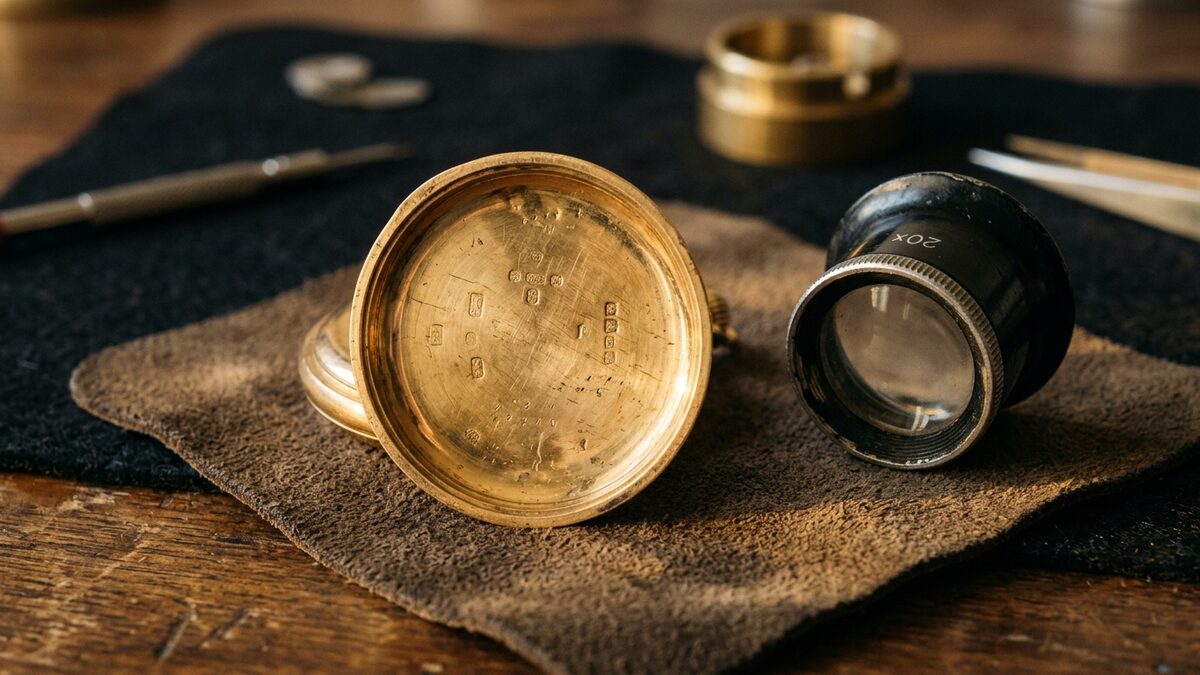
Hallmarks are not decoration. They are a legal record, struck into the metal at the point of assay, and the discipline of reading them begins with knowing where to look. On a wristwatch, the marks usually live on an inside surface: the caseback interior, the lug recess, or the edge of the case where the back seats. A maker who intended the marks to be permanent placed them where handling would not wear them away. That alone is a useful cue. Marks stamped in an exposed, high-contact spot deserve a second look.
Where a genuine hallmark sits, and what it should say
The core of any gold hallmark is the fineness figure. Modern European marks state purity in parts per thousand: 750 for 18-carat, 585 for 14-carat, 375 for 9-carat. Older or non-European cases may use a carat figure instead, such as an 18K stamp, though a bare 18K on its own carries less authority than a struck assay mark backed by a national office. Alongside the fineness you often find a sponsor's or maker's mark, and, on assayed pieces, a national assay symbol: the Helvetia head used on Swiss gold cases, for instance, or the various standard marks of other assay offices.
Consistency is the thing to read for. A genuine set of marks shares a visual language. The strikes sit at a similar depth, the typeface matches across the numerals and symbols, and the whole cluster reads as struck by the same tooling in one operation. Marks that vary wildly in depth, that mix crisp modern digits with a worn old symbol, or that appear in an unexpected order are worth questioning. None of this is proof on its own, but inconsistency is the first thread worth pulling.
Placement and geometry also matter. A struck hallmark displaces metal, so a genuine mark usually shows a slight raised lip at its border and clean, sharp interior walls. A mark that has been etched, laser-scored, or cast into a reproduction case tends to look shallow, rounded, or oddly uniform, without the small distortions that a physical die leaves behind. Under a loupe, the difference between struck and printed is often plain once you have seen a few honest examples.
Some hallmarking systems add a date letter, a small coded character that fixes the year of assay, and a town or assay-office mark that fixes the place. Where these exist, they are a gift to anyone dating a case, because they can be cross-referenced against published tables. They also raise the bar for a forger, who must not only reproduce a fineness mark but keep the date and office marks internally coherent with each other and with the watch's presumed era. A case claiming a mid-century origin whose date letter belongs to a different decade is quietly telling on itself.
Solid gold, plating, and the tells under close inspection
The distinction between a solid-gold case and a plated one is where a lot of pre-owned confusion lives. Plated cases were made in enormous numbers, and many wear a mark that reads plausibly at a glance. Look for terms and abbreviations that signal a surface layer rather than solid metal: plaqué or, gold-filled, rolled gold, and the caliber notations such as 20 microns that describe a plating thickness. These are honest descriptions of a coated case, and they are not the same as a fineness hallmark.
Weight and wear give the rest away over time. Solid gold carries a density you can feel once your hands know the reference; a plated brass case of the same size feels notably lighter. Wear tells the longer story. On a plated case, the high points, lug edges, caseband corners, and the crown, eventually show a warmer base metal breaking through the surface, often as a subtle color shift from yellow to a pinker or grayer tone. Solid gold wears without changing color, because the metal is the same all the way through. A case that shows two different colors at its wear points is telling you something about its construction.
Formal testing exists for the cases where the eye cannot settle the matter. Non-destructive methods such as X-ray fluorescence can read surface composition, and a specialist can interpret the results against what the case appears to be. These belong in the hands of an assay office or an experienced dealer rather than a first inspection at a table, but knowing they exist changes how you weigh what you see: the loupe stage is about deciding whether a case earns that closer scrutiny, not about reaching a verdict alone.
Absent marks call for a measured reading rather than alarm. A genuine case can lose its marks legitimately: heavy polishing over decades can soften a caseback interior, a service replacement back may never have carried the original assay, and some early or export pieces were marked lightly. What matters is whether the story the case tells is internally consistent. A caseback whose marks have been polished nearly flat, on a case whose lugs still show crisp edges, is a small contradiction worth noting. So is a pristine, sharply struck mark on a case that is otherwise heavily worn.
Originality of the parts is its own question, related but separate. A gold case can be genuine while wearing a replacement caseback in a different metal, or a crown that was never gold at all. Reading the marks part by part, rather than treating the case as one object, is what catches these mixed histories: a solid-gold middle case with an unmarked steel back is not a fake so much as a composite, and the price and the description should reflect that honestly.
Reading a case this way will not settle every question, and it is not meant to. It narrows them. A coherent set of struck marks, in the right place, at a purity consistent with the case's weight and wear, supports the rest of an inspection rather than replacing it. When the marks and the metal disagree, that disagreement is the useful signal, and the reason to slow down, gather better light, and, where the sum is significant, ask an assay office or an independent specialist to confirm what your loupe has begun to suggest.