
Reading Clasp Codes on Pre-Owned Bracelets
A bracelet clasp is the quietest part of a watch to inspect, and one of the more informative. Inside it, a few stamped characters can place the bracelet in time.
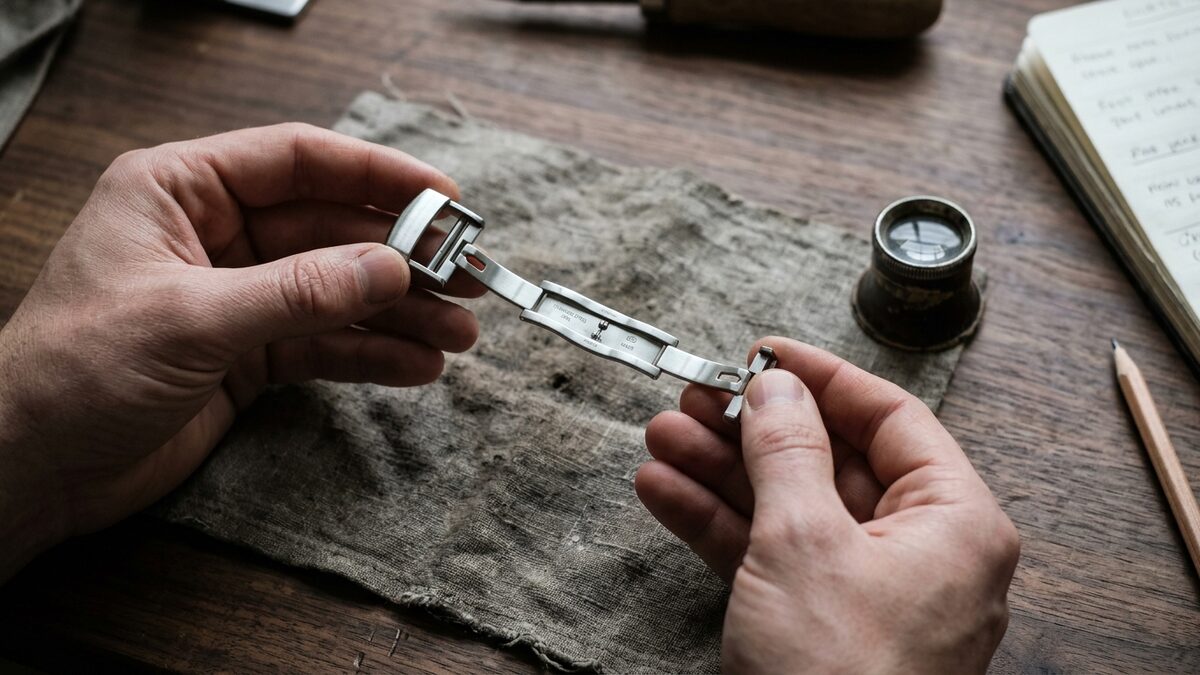
Start with the clasp open. On an Oyster-style bracelet, the stamping sits on the inside of the swing arm; on a Jubilee, look at the inner face of the folding blade. The engraving is tiny, so a jeweller's loupe or a phone camera in macro mode does most of the work. Photograph it in raking light, because a flat reflection can erase a shallow stamp.
You will usually find two lines. The first is the bracelet reference, a number such as 78360. The second is the clasp date code, something like K, DE4 or OP6. The reference tells you which bracelet it is; the date code tells you roughly when it was made.
That second line is the useful one. Rolex publishes no official archive for these codes, but collectors have cross-referenced correspondence charts covering 1976 to 2010. They are one of the few ways to test whether a bracelet is consistent with the watch it is fitted to. Treat the chart as a reference tool, not as a certificate.
The earliest system is the simplest. From 1976 to 1999, a single letter was stamped, sometimes preceded by a V between 1976 and 1981, so VA and VB read the same as A and B. A neighbouring digit, 1 to 12, gives the month of production. A sample of the letters:
- A (VA): 1976
- E (VE): 1980
- K: 1986
- O: 1990
- S: 1994
- V: 1996
So a clasp stamped K with a 5 beside it would point to May 1986. The chart also lists T or W for 1995 and puts V at 1996 and Z at 1997, a reminder that the letters do not run strictly in alphabetical order. Read the chart in full rather than from memory.
Later stamps, such as DE4 or OP6, take a different shape from the single letter and need the later section of the chart. The method is the same: look the stamp up exactly as it appears, and note which period it implies. Where a character is worn or ambiguous, say so in your notes instead of guessing, because a misread letter produces a confident but wrong year.
The stamp matters mostly in comparison. Set the clasp's implied date beside the era of the watch itself, drawn from the case reference and serial number. The code reflects when the bracelet was made, not when the watch was assembled, so a small gap is reasonable to expect. A clasp dated a decade or more away from the head is a different matter, and it is worth a direct question.
There are ordinary explanations for a mismatch. A bracelet may have been replaced during a service, swapped for a different style, or paired with a head from another period. None of these is a flaw by itself, but each changes how a watch should be described. A collector seeking a period-correct piece wants the bracelet to belong to the era, and a seller should say plainly when it does not.
The reference line deserves the same scrutiny. If a listing says Oyster and the reference belongs to a Jubilee, or the reverse, the discrepancy is plain. The charts distinguish Oyster, Jubilee and President references, which is enough to confirm that the bracelet type matches what the description states.
A short routine keeps the check honest:
- Open the clasp fully and photograph both stamped lines in macro.
- Record the reference and the date code exactly as stamped, including any leading V.
- Read the letter against the chart, and the adjoining digit as the month.
- Compare the implied year with the era of the case and serial number.
- Ask for the service history if the two periods disagree.
A few limits are worth stating. The charts come from collectors, not from a maker's archive, and the material here covers one maker's clasps only. Other brands use their own conventions, which should be checked against references written for those brands. A matching stamp supports originality; it does not prove it, and no single marking on a clasp should carry the whole judgment on a watch.
Read this way, the clasp is a small, quiet witness. It records when one part of the watch was made, and the only task is to see whether that account agrees with everything around it.