
Over-Polishing and the Loss of Original Case Geometry
A case leaves the workshop with intent. Every plane is defined, every edge meets its neighbor at a deliberate angle, and the contrast between a satin flank and a mirrored bevel is drawn as cleanly as a pencil line. Years of ownership, and the well-meaning hands of successive polishers, slowly blur that drawing. Learning to read what remains is one of the quieter skills in evaluating a pre-owned object, and one of the most revealing.
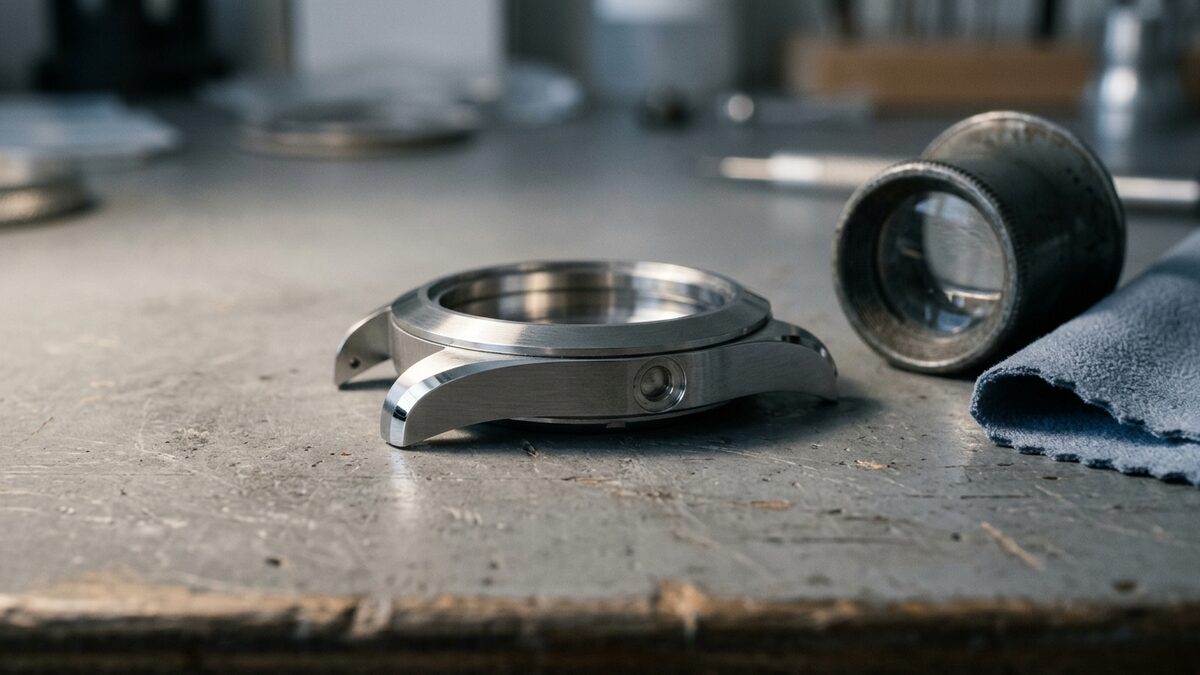
The first thing worth understanding is that polishing removes metal. It does not fill or restore; it abrades. Each pass across a wheel takes a fine layer from the surface, and the surface that disappears fastest is the one that stands proudest: the edge. A case that has been refinished several times over decades will show the cumulative cost of that abrasion at its corners, where crisp intersections soften into gentle rolls. The metal has not been added back anywhere. It has simply been carried away, a little at a time, until the geometry the designers specified no longer exists.
This matters because case geometry is the signature of a reference. Two examples of the same model, one factory-fresh and one refinished four times, can differ by a surprising margin in the width of a bevel, the height of a lug, and the tautness of a caseband. The refinished example often looks perfectly acceptable in isolation. It is only against a known-original reference, or a trained eye, that its softness becomes legible.
Reading the Brushed-to-Polished Transition
Many cases combine two textures: a brushed or satin finish across the broad top surfaces and a polished treatment on the bevels and flanks. The line where these two meet is the single most honest witness to a case's history. On an original surface, that transition is a sharp seam. The satin stops and the polish begins along a defined edge, with no ambiguous zone between them.
When a case is polished by someone working quickly, or working too often, the mirror finish tends to creep onto surfaces that should be brushed. A polisher rounds the bevel, catches the adjacent satin plane, and blends the two rather than respecting the seam. The result is a soft gradient where there should be a clean border. If you look across the top of a lug and cannot say precisely where the brushing ends, you are almost certainly looking at a surface that has migrated from its original state.
A few habits help here:
- Tilt the case under a single light source and watch how the reflection breaks. An original seam breaks the reflection abruptly; a blended one smears it.
- Compare left and right sides of the same case. Asymmetry between them is a strong signal of uneven refinishing.
- Look for polish intruding into recesses, engravings, or reference numbers between the lugs. Softened or shallow markings suggest the wheel has passed over them.
None of these observations require magnification beyond a loupe, and most reveal themselves to the naked eye once you know what you are asking of the surface.
What Full Lugs and Crisp Bevels Reveal
Lugs are where over-polishing announces itself most plainly, because they are thin, they protrude, and they are handled constantly. A factory lug has mass. Its tip is defined, its flanks are parallel or taper by design, and its underside meets the caseband along a clean line. As metal is removed over successive refinishings, the lug narrows, its tip rounds, and its profile grows thin and tired. Watch collectors sometimes describe this as the lug losing its fullness, and the phrase is apt: the volume that should be there has quite literally been polished away.
Bevels tell a parallel story. A chamfer running along the edge of a case or lug is meant to be a flat, defined facet catching light as a bright ribbon. When original, that ribbon has consistent width and straight borders along its whole run. When over-polished, it widens unevenly, its edges wander, and in extreme cases it disappears into a rounded shoulder where a distinct facet once lived. Run your eye along the length of a bevel and ask whether it holds a constant width. If it swells and shrinks, the geometry has been compromised.
There is a useful mental exercise for all of this. Imagine the case as a set of intersecting planes rather than a single curved object. Original cases are architectural: they are built from flats and defined edges, and even their curves are disciplined. Heavily refinished cases drift toward the organic, everything rounding and merging as the edges wear down. The more a case reminds you of a river stone, the more metal has left it.
None of this is an argument that a polished case is worthless. A gentle, competent refinish that respects the original lines is part of a healthy object's life, and many desirable examples have been touched at least once. The distinction that matters is between refinishing that honors the geometry and refinishing that erodes it. A single careful pass by a skilled hand can leave a case looking correct for another generation. Repeated careless passes leave it soft, thin, and quietly diminished, regardless of how bright it shines under the counter light.
The practical takeaway is to weight geometry above gloss. A brilliant mirror finish is easy to produce and easy to be seduced by. Sharp edges, honest transitions, and full lugs are far harder to fake, because they can only be preserved, never recreated. When you evaluate a pre-owned case, look past the shine and study the structure underneath it. The metal that remains, and the precision with which it still holds its intended shape, tells you more about how an object has been cared for than any amount of surface brightness ever could.