
Lug-to-Lug and Case Thickness: Why Fit Matters More Than Diameter
Diameter is the first number every collector learns and the last one that should decide a purchase. A 40mm case can overwhelm a slim wrist, and a 42mm case can disappear beneath a cuff, depending on two measurements buyers rarely check before clicking purchase.
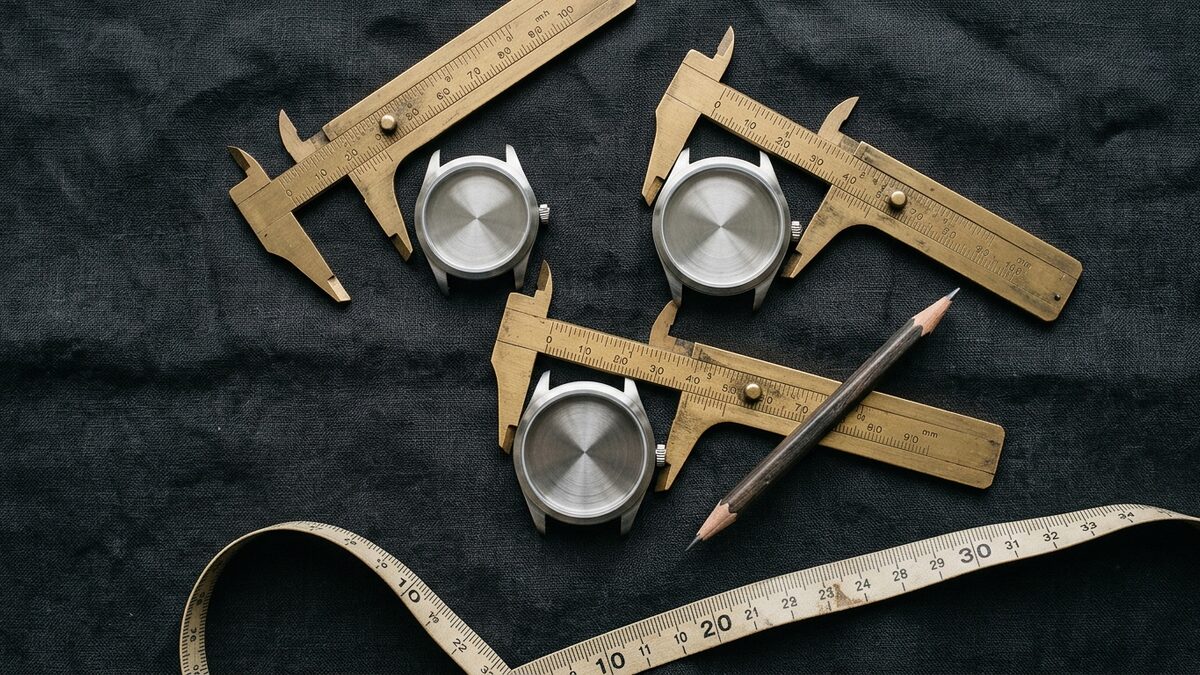
The pre-owned market trains buyers to filter by diameter. Listings lead with 39mm, 40mm, 42mm, and shoppers calibrate expectations against that single figure. The problem is that diameter only describes the circle of the case when viewed from above. It says nothing about how far the watch reaches across the top of the wrist, and nothing about how high it sits above the skin. Those two measurements, lug-to-lug span and case thickness, do most of the work of determining whether a watch feels balanced or borrowed.
Lug-to-lug refers to the distance from the tip of one upper lug to the tip of the opposite lower lug, measured in a straight line across the caseback. On a watch with short, downturned lugs the lug-to-lug figure may be only two or three millimetres larger than the diameter. On a watch with long, flat lugs the same diameter can produce a lug-to-lug span six or seven millimetres greater. That difference is the difference between a case that follows the curve of the wrist and one that hangs off the edges.
The practical rule most experienced buyers settle on is that lug-to-lug should not exceed the flat width of the wrist measured from the inside of one wrist bone to the other. A wrist that measures 56mm across that flat plane can comfortably carry a watch with a 54mm lug-to-lug. A 58mm lug-to-lug on the same wrist will visibly overhang, and the strap or bracelet will angle downward immediately at the lug exit, which produces an unbalanced silhouette and accelerates wear on spring bars.
Case thickness is the second measurement that quietly determines fit. A 40mm case at 9mm thick reads as restrained and slips beneath a shirt cuff without protest. The same 40mm case at 14mm thick sits noticeably proud, catches on cuffs, and shifts the visual weight upward in a way that makes the watch appear larger than its diameter suggests. Vintage-inspired releases over the last several years have leaned into slimmer profiles for exactly this reason, and the second-hand market has rewarded that direction with stronger residuals on thinner references.
How the three measurements interact on the wrist
A useful exercise before any pre-owned purchase is to plot all three numbers together rather than treating diameter as the headline. A 42mm sports chronograph at 13mm thick with a 50mm lug-to-lug will wear smaller and more comfortably than a 40mm dress watch at 11mm thick with a 52mm lug-to-lug, because the chronograph's lugs are shorter and curve downward more aggressively. Photos do not capture this. Even wrist shots from sellers tend to be cropped in ways that flatter the proportions and hide the overhang.
The interaction between thickness and lug span also affects how the watch behaves under motion. A thick case with a long lug-to-lug tips forward as the wrist rotates, because the centre of mass sits higher and further from the pivot point of the wrist bone. Buyers often describe this as the watch feeling top-heavy or unsettled, and they assume the cause is the bracelet or the strap. The cause is usually the geometry of the case itself, and no strap change will correct it.
Strap choice can soften but not eliminate poor geometry. A supple leather strap with curved ends can compensate for a lug-to-lug span that runs slightly long, because the strap will bend at the lug exit and follow the wrist's curve. A stiff integrated bracelet on the same case will not bend at all, which exposes every millimetre of overhang. This is why integrated bracelet watches require closer attention to lug-to-lug numbers than strap watches do, and why the secondary market for integrated designs tends to be more brutal about fit-related returns.
For pre-owned buyers, the practical takeaway is to request three measurements from any seller before committing: diameter, lug-to-lug, and thickness, ideally with calipers visible in the photo if the seller is willing. Manufacturer spec sheets are a reasonable starting point but production tolerances and case revisions across reference years can shift the actual figures by half a millimetre or more. Half a millimetre matters at the edges of fit, and the edges of fit are where most regretted purchases live.