
How to Tell if a Pre-Owned Watch Is Authentic
The fastest way to tell whether a pre-owned luxury watch is authentic is to examine the object closely and compare every detail against the maker's known references: the weight in the hand, the sharpness of the printing, the finishing of the movement, and the serial and reference numbers. No single clue is decisive, but read together they tell a reliable story.
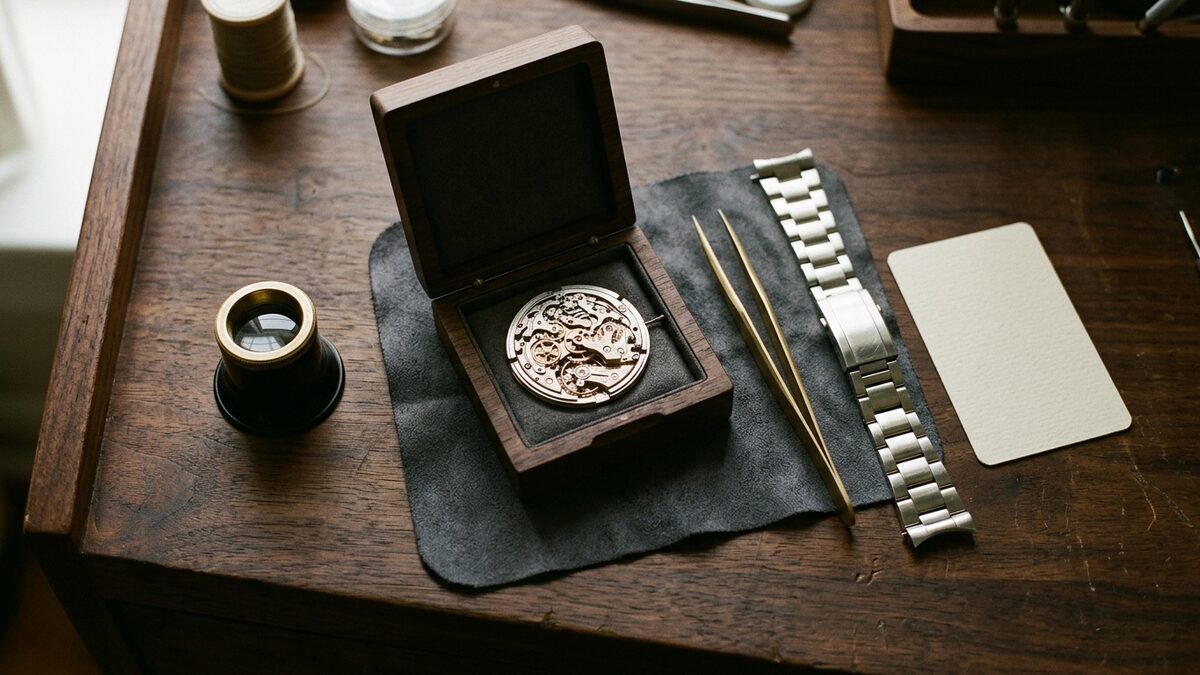
Authenticating a pre-owned watch is not about one dramatic reveal. It is a series of small, patient observations that either agree with each other or they do not. A careful buyer works from the outside in, then confirms what the object says about itself against what the manufacturer actually produced. None of the following checks requires specialist equipment beyond a loupe and good light, though the most valuable step, opening the case, is best left to a watchmaker. Taken together, they let you buy with confidence rather than hope.
Start With the Case, Dial, and Printing
A genuine luxury watch is engineered to tolerances that are difficult and expensive to copy, so the first authenticity checks are the ones you can make with your own eyes and hands. Pick the watch up. Most quality mechanical pieces carry a reassuring density, the result of solid metal cases and movements rather than hollow castings. A watch that feels conspicuously light for its size deserves closer attention.
Look at the case geometry next. On an authentic piece the lugs are evenly finished, the transitions between brushed and polished surfaces are crisp, and the bezel sits true with no play. Screw-down crowns thread smoothly without grinding. Caseback edges, lug holes, and chamfers are clean rather than rounded or soft, which is where lower-grade reproductions tend to give themselves away.
The dial rewards patience. Under a loupe, printing on a genuine watch is sharp and perfectly aligned, with no bleeding ink, uneven spacing, or crooked indices. Applied markers and logos sit flush and symmetrical, and lume is applied evenly. Compare the exact font, the position of the text, and the spelling against reference photographs of the same model and production year, because small typographic differences are among the most common tells.
Work the crystal and the date, if the watch has one. A cyclops magnifier should enlarge the date to the maker's stated factor and center it in the window. Sapphire crystals resist scratching and shed water in tight beads. The seconds hand on a mechanical movement should sweep in fine increments rather than tick once per second, though quartz models are a legitimate exception.
Do not overlook the bracelet or strap and its clasp. On genuine metal bracelets the links are solid, the end links fit the case precisely with no rattling gap, and engravings on the clasp are deep and even. The clasp should close with a confident, well-machined snap. Leather straps on serious watches use quality hide and tidy stitching, and the buckle carries the same finishing standard as the case. Flimsy hardware rarely accompanies a real movement inside.
Read the Movement, the Numbers, and the Paperwork
If a trusted watchmaker can open the caseback, the movement is the most honest witness of all. Authentic calibers show consistent finishing: cleanly cut bridges, properly fitted screws with undamaged slots, engraved rather than stamped markings, and decoration that matches what the manufacturer used for that reference. Reproductions often hide a generic movement behind a convincing exterior, so a mismatch between the dial side and the mechanism is a serious warning.
Automatic watches offer one more clue through the rotor, the weight that winds the movement as the wrist moves. On authentic pieces it spins freely and quietly, and any engraving on it is precise. Listen, too: a genuine mechanical movement is generally smooth and restrained, while a loud or rattly sound can point to a cheap substitute caliber. These impressions are subtle, which is exactly why comparing against a known-good example of the same reference matters so much.
Serial and reference numbers are the next cross-check. On a genuine piece these are engraved crisply and legibly, in the locations the maker is known to use, whether between the lugs, on the caseback, or on the rehaut. Confirm that the reference number corresponds to the model in front of you and that the serial falls within a plausible range for its era. Numbers that are shallow, uneven, or acid-etched are a reason to stop.
Paperwork supports the watch; it does not replace the inspection. Original boxes, warranty cards, and service records add confidence when the details on them agree with the watch itself, including matching serial numbers and dates that make sense together. Treat documents with suspicion when the card is blank, the serial does not match, or the paperwork looks newer than the watch. A complete set is reassuring, but convincing papers have been faked, so the object must still pass on its own merits.
The most reliable safeguard is the source. Buying through an established, authorized dealer places the watch in front of trained eyes before it reaches you, and it gives you recourse if something is wrong. Watches sold through MyEssentialSwiss authorized dealer partners include a two-year warranty covering movement defects, parts, and labor; to confirm exactly what your coverage includes, contact warranty support before you buy. When in doubt about any single piece, a professional authentication by a qualified watchmaker is money well spent.