
Blued Hands and Heat Treatment: Reading Thermal Finishing on a Pre-Owned Watch
Few details reward close attention like a blued hand. Held at the right angle, flame-blued steel shifts from near-black to a deep cornflower, then to violet at the edges. That color is not paint; it is the visible record of a temperature reached and held. For anyone assessing a vintage or pre-owned piece, the way a hand takes and keeps its blue is one of the more honest signals a case back cannot hide.
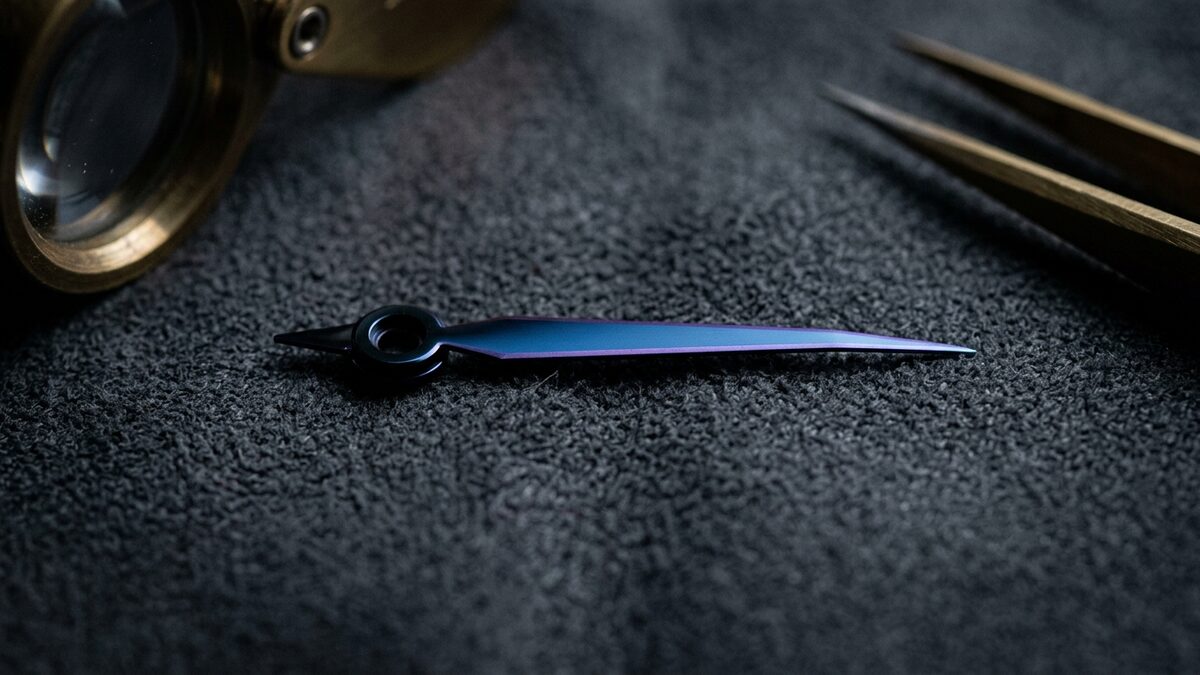
Thermal bluing is an old craft. A polished steel hand is brought to roughly 290 degrees Celsius, at which point a thin oxide layer forms on the surface and refracts light into blue. Push the heat a little further and the tone drifts toward grey; pull it too early and the color stays pale and uneven. The finisher is reading the metal by eye, and the result is a color that sits in the steel rather than on top of it. Because the oxide is only a few hundred nanometers thick, the underlying polish shows through, which is why a properly blued hand seems to glow rather than simply appear dark.
Chemical bluing and coated blue are different animals. A chemical bath can produce a serviceable blue at lower cost and with more consistency, but the tone is often flatter and reads the same from every angle. Painted or PVD-coated hands, common on later or more affordable references, give a saturated, uniform blue that does not travel through the spectrum as the light moves. None of these is inherently a fault. The point for a careful buyer is that the finishing method should match what the reference is documented to use. A piece that ought to carry flame-blued hands but shows a flat, angle-stable blue deserves a second look.
Reading heat-treated steel under angled light
The single most useful test costs nothing. Take the piece under a directional light source, ideally a small point of light rather than a diffuse room, and rotate it slowly through perhaps forty-five degrees. Flame-blued steel will move: the crown of the hand may read almost black head-on, then open into blue and finally into a warmer violet along the polished bevel. That gradient is the signature of an oxide layer over a mirror polish. Coated or painted hands stay put; the blue is the blue from any angle.
Look next at the transitions. On genuine thermal work the color tends to shift gradually along the length of the hand, since heat does not arrive perfectly evenly across a thin piece of steel. Small variations from hand to hand on the same dial are normal and, on vintage pieces, expected. What should give pause is the opposite: a blue so uniform it looks printed, or a color that ends in a hard line rather than easing out. Uniformity beyond what the era's tooling could produce is a quiet argument for later intervention.
Pay attention to the polish beneath the color as well. Because thermal blue depends on the surface under it, a hand that has been re-polished and re-blued will sometimes show slightly rounded edges where the original crisp bevels have softened. Under magnification, original bevels read as sharp facets catching light in clean lines. Re-worked steel can look a touch molten at the edges, and the blue over it may sit a shade too even because the finisher chased consistency the factory never had.
How blued hands age, and what refinishing tells you
Heat-treated steel ages in ways that are informative rather than merely cosmetic. The oxide layer is thin and can be abraded, so the tips of hands, the points most exposed to handling and to the underside of a crystal, are often where blue thins first, revealing a hint of bright steel. Humidity and time can also nudge the tone; a hand that once read pure blue may drift toward a slate or brown-grey on a piece that has lived a hard life. This kind of even, gentle aging usually reads as honest wear consistent with the rest of the dial.
Spot discoloration is a different message. Isolated brown or rust-toned patches, particularly near the mounting hole or along one edge, can indicate moisture ingress and possible corrosion of the underlying steel. That is a condition note worth weighing, since corrosion under an oxide layer does not reverse. When the hands look pristine but the dial and case show clear age, consider whether the hands have been serviced or replaced. Replacement hands are not automatically a problem on a piece meant to be worn, but they change the conversation around originality, and originality is much of what a considered buyer is paying for.
Refinishing leaves its own tells. A hand re-blued during service will often carry a color that is technically correct but tonally out of step with the era, cleaner and more saturated than a sixty-year-old oxide should be. Set the hands against the aged luminous material and the patina of the dial: if everything else has mellowed and the blue looks factory-fresh, the hands have likely been touched. Conversely, a set of hands whose aging matches the dial, the same warmth, the same slight fade, tends to support a coherent, untouched story.
The reward for this attention is a clearer read of the object in front of you. Thermal bluing is one of the few finishing choices a maker cannot fake cheaply and a seller cannot easily hide, because it responds to light in a way that either matches the reference or does not. A collector who learns to rotate a piece under a single point of light, watch the color travel, and compare that travel against what the reference should show, holds a genuinely useful instrument. It will not settle every question of authenticity on its own, but it narrows them, and it turns a small blue detail into a quiet, legible account of how the object was made and how it has been kept.