
Gasket Aging and Pre-Owned Water Resistance
A water resistance rating is stamped into the caseback and printed in the catalogue, but it describes the watch as it left the workshop, not the watch sitting in front of you. On a piece that has spent a decade or two changing hands, that number is a historical note, not a live measurement.
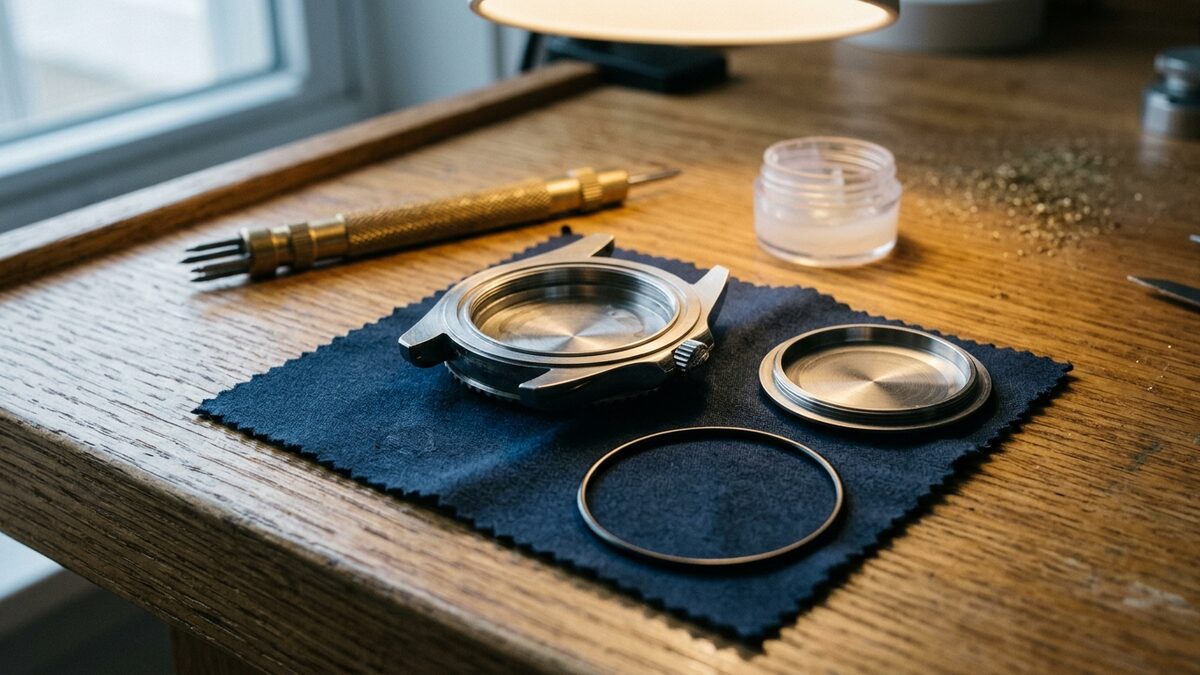
Water resistance in a wristwatch is not a property of the case metal or the crystal. It is a property of the small rubber and synthetic seals seated between those parts: a gasket under the caseback, one or more around the crown stem, and a ring beneath the crystal. Each is a compressible barrier, holding a fraction of a millimetre of tension against the outside world. When they are fresh, pliable, and correctly seated, they keep water out. When they are not, the rest of the watch cannot compensate.
How Rubber Seals Lose Their Grip Over Time
Gaskets fail slowly and quietly. Rubber is a living material in the sense that it changes chemistry with exposure. Heat drives out plasticisers and leaves the ring stiffer and less able to spring back into shape. Skin oils, sunscreen, chlorinated water, and solvents attack the surface. Ultraviolet light accelerates the whole process. Over years, a seal that once flattened evenly into its channel becomes brittle at the edges, develops fine cracks, or takes a permanent set: it keeps the compressed shape it was last held in and no longer pushes back.
Compression itself is part of the story. Every time a caseback is opened for a battery or a service, the gasket is disturbed and, ideally, replaced. If it is reused, it seals against a memory of its old position rather than a fresh one. Crown gaskets suffer the most, because they are worked constantly: every winding, every time-setting, every push back into the case drags the seal across the stem. A crown that has been operated thousands of times has a gasket that has been abraded thousands of times.
It helps to picture the everyday demands placed on those seals. A watch worn daily meets warm skin, cold air, hot showers, and the occasional hand-washing, each cycle expanding and contracting the case by a hair. A gasket that has kept its elasticity absorbs that movement; a hardened one lets a thread of moisture creep past on a temperature swing it would once have shrugged off. This is why two watches of the same model and the same age can behave completely differently. One may have lived in a drawer, opened once for a battery by a careful hand; the other may have been worn hard, opened repeatedly, and closed each time on the same tired ring.
None of this shows on the outside. A case can be polished to a mirror, the dial can be immaculate, and the movement can run beautifully, while the seals inside have quietly reached the end of their working life. This is why the depth figure engraved on the back tells you so little about a pre-owned example. It records an intention set at manufacture, tested on a new watch with new gaskets. It says nothing about how the piece was stored, how often it was opened, or whether the last person to close the caseback used a fresh seal and the correct tools.
What a Pressure Test Can and Cannot Tell You
A proper inspection replaces guesswork with measurement, but it is worth understanding what the measurement covers. A dry test places the watch in a chamber and varies the air pressure, watching for the case to flex as air migrates past a compromised seal. A wet test submerges the watch under pressure and looks for bubbles. Both assess the case as a sealed system at a moment in time. Neither can tell you how much life remains in the gaskets, only whether they hold today.
That distinction matters for a buyer. A watch that passes a pressure test on the inspection bench has demonstrated integrity under controlled conditions. It has not demonstrated that it will survive a temperature swing, a knock to the crown, or another two years of wrist heat. A test is a snapshot, not a forecast. The sensible reading of a clean result is that the case is sound now and that the seals were competent when checked, which is genuinely useful, provided nobody mistakes it for a promise about the future.
There is also the question of who did the last work. A pressure test is only as meaningful as the hands that closed the case afterward. A gasket lightly greased with the right silicone, seated square, and torqued to specification behaves very differently from one pinched slightly out of its groove by a hurried caseback press. None of that is visible once the watch is buttoned up, which is why a documented service from a competent workshop carries weight that a bare figure on the caseback never can.
An inspection can reveal a great deal beyond the pass or fail. A technician who opens the case can see whether the gaskets are original or recently changed, whether they sit correctly in their channels, and whether the sealing surfaces show corrosion or old adhesive. Rust spots, water staining on the movement, or a tidemark on the dial edge are quiet confessions of a past intrusion, even one long dried out. Those signs matter more than any single test, because they describe the history the number cannot.
The practical position for anyone buying a pre-owned piece is calm and specific. Treat the engraved rating as a description of the watch when it was new. Ask when the seals were last serviced and whether a pressure test was done as part of that work. If the watch is being sold as water resistant, expect that claim to rest on a recent test, not on the catalogue. And if you intend to wear it near water, plan on a fresh service and a new set of gaskets regardless of what the back says, because the only seals you can trust are the ones a technician has just seen.