
Franken Watches: Spotting Mixed-Part Builds
A franken watch rarely announces itself. It arrives coherent at a glance: a clean dial, an honest case, a story that holds together for the length of a conversation. Recognizing one begins where the eye prefers to stop, at the quiet seams between parts that were never meant to share a caseback.
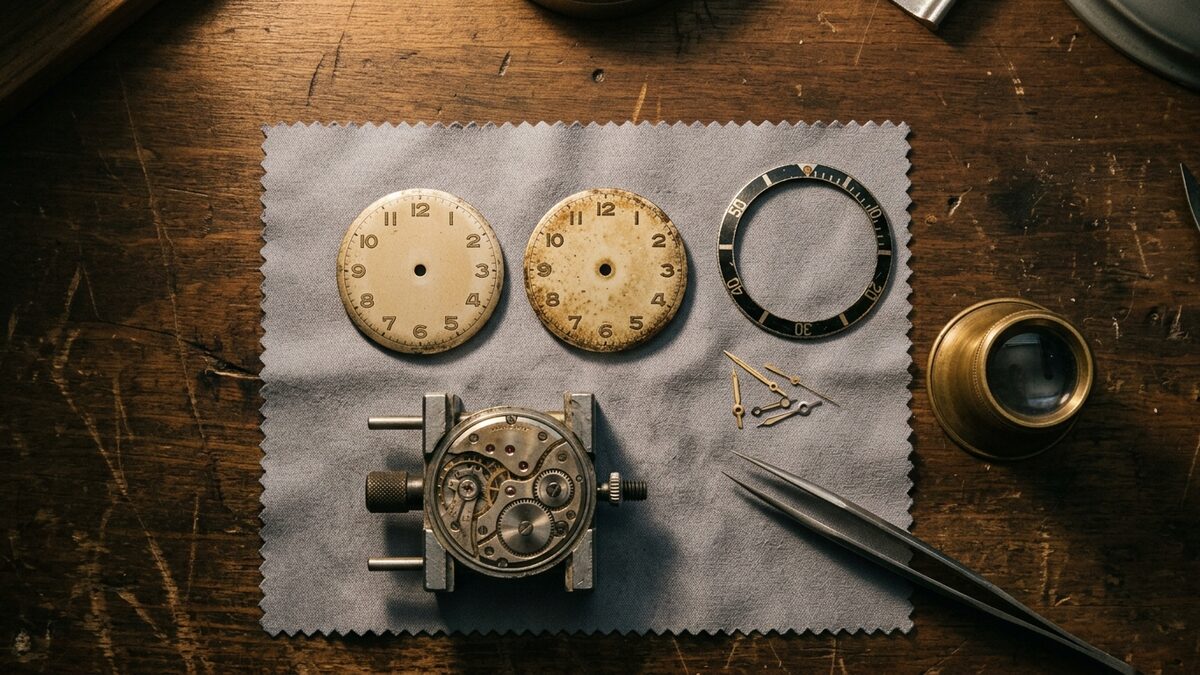
The term describes an object assembled from components drawn across references, production years, or in the least honest examples, across entirely different makers. Some were built to deceive. Many were not. A watch that lost its dial to moisture, or its hands to a clumsy service decades ago, may have been rebuilt with whatever a workshop had on the bench. The result is the same either way: a piece that reads as one thing and is, on inspection, several.
What makes these builds difficult is that each individual part can be genuine. The dial is real. The hands are real. The movement runs, keeps time, and carries the correct signatures. The deception, when there is one, lives not in any single element but in the relationships between them. A coherent watch is internally consistent across a dozen small decisions the manufacturer made in a given year. A composite object breaks that consistency somewhere, and the work is learning where to look.
Why composite builds pass the first glance
The first glance is generous by design. We recognize a familiar reference by its silhouette, its dial layout, its overall proportion, and once those register, the mind fills in the rest. A franken build exploits exactly this. It presents the correct outline and lets assumption complete the picture. Sellers who understand this photograph the watch at the angles that flatter the silhouette and obscure the joins.
Generational drift is the most common tell, and the hardest to see without reference material. Manufacturers revise their references constantly and quietly. A dial print shifts by a fraction of a millimetre. A lume compound changes color as the formula is reformulated. A handset gains a slightly different taper. Individually these changes are invisible. But a dial from one production window paired with hands from another produces a mismatch of era that a trained eye reads as wrongness before it can name the cause.
Patina is the second great equalizer, and it is routinely faked or, more often, simply mismatched. Aged lume on a dial should be answered by aged lume on the hands, in the same tone, because they sat under the same crystal for the same decades. When the dial has gone a warm cream and the hands remain bright, the pairing is suspect. The reverse holds too: freshly relumed hands against an untouched vintage dial betray a service that replaced more than it should have.
Reading the object for internal contradictions
Begin with reference logic. Every genuine watch obeys the rules of its own reference: a particular case profile, a particular crown, a particular bezel treatment, a movement that belongs to that generation. When a bezel insert shows a font or a shade that the reference never used, the question is not whether it is attractive but whether it is correct. Aftermarket bezels are among the easiest parts to swap and among the easiest to source, which makes them a frequent point of substitution.
Move inward to the movement. A caseback that opens onto a caliber inconsistent with the reference is the clearest evidence of all, because the movement is the least visible part and therefore the part sellers assume no one checks. Serial and reference engravings that disagree with the movement generation, or that show finishing inconsistent with the era, tell the same story. Numbers should corroborate one another; when they contradict, the object is speaking honestly even if the seller is not.
Finishing rewards patience. A dial refinished outside the factory rarely matches original print density, and the texture of the lacquer often differs under raking light. Applied markers should sit with uniform height and identical reflectivity; a single replaced marker catches the light on its own schedule. Hands should share one finishing signature across the set, hour, minute, and seconds alike. A seconds hand that gleams differently from its siblings arrived later than they did.
None of these signals is conclusive alone. A serviced watch with a correct replacement part is not a franken build; it is a serviced watch, and honest sellers disclose the work. The judgment lies in accumulation. One anomaly invites a question. Two invite scrutiny. A pattern of them, spread across dial, hands, bezel, and movement, describes an object assembled rather than born, and the price should reflect a parts watch rather than a coherent example.
The practical defense is unglamorous. Study the reference before you study the listing. Collect period-correct images from sources you trust. Ask for the caseback open, the movement pictured, and the lume shown under the same light as the dial. A seller with a coherent watch answers these requests without friction. Hesitation is itself information. The goal is not suspicion for its own sake but literacy: the ability to see an object as the sum of its decisions, and to notice when those decisions were made by different hands in different years.