
Dial Patina on Pre-Owned Watches: Tropical, Spider, and Honeycomb Explained
Among pre-owned watch listings, few words carry as much weight, or as much ambiguity, as patina. The term covers a spectrum that runs from quiet warmth in a once-black dial to fractures that read more as failure than as character. Three patterns appear most often in catalog copy: tropical, spider, and honeycomb. Each forms through a different mechanism, each tells a different story about how an object was stored, and each shifts value in a different direction.
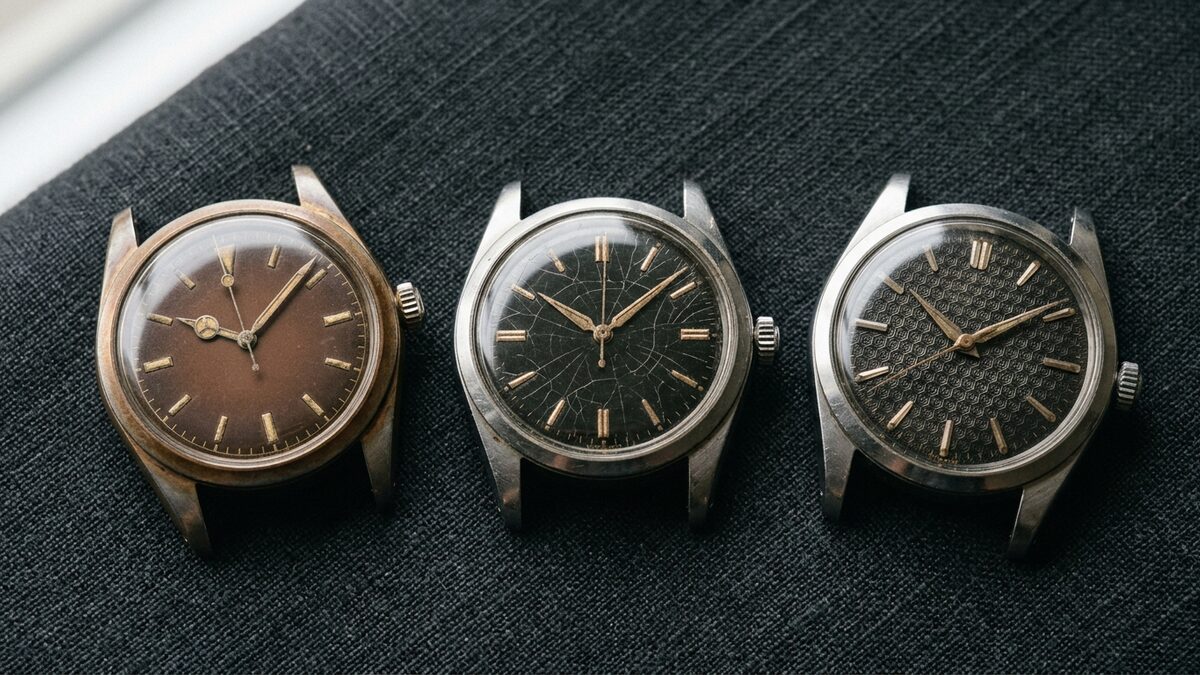
Patina is not a single phenomenon. It is shorthand for the visible record of decades spent reacting to light, humidity, and the slow chemistry of lacquer, paint, and luminous compound. A dial begins life as a flat surface engineered to look uniform under display lighting. Time introduces variables. The variables are not always graceful, but when they are, the result can lift a watch above its peers in ways the original maker never planned.
Reading patina correctly requires separating three things: the cause, the visible pattern, and the market's interpretation. The first is chemistry. The second is what a buyer sees through a loupe. The third is the consensus that has accreted around certain looks over the past two decades of pre-owned trading. All three need to align before a description like tropical or spider should change what a watch is worth.
Tropical Dials: Warmth That Began as Black
A tropical dial is one that has shifted from its original black or dark blue to a brown, chocolate, caramel, or warm bronze tone. The shift is uniform, or close to uniform, across the dial face. The cause is sustained ultraviolet exposure acting on the binder in the original lacquer or paint. Certain formulations used through the 1960s and into the early 1970s contained pigments and resins that broke down predictably under sunlight, fading toward warmer tones rather than gray or chalk.
Not every old dial turns tropical. The shift depends on the specific paint chemistry, the storage conditions across decades, and a degree of luck. A watch worn daily on a wrist in a sunny climate is more likely to develop the pattern than one stored in a drawer. Cases with weaker gaskets sometimes accelerate the process by admitting trace moisture and warmer interior temperatures.
Reading a tropical dial well means looking for evenness. A genuine, market-recognized tropical shift presents as a smooth gradient or a uniform warm tone across the entire dial. Mottling, dark patches, or sharp edges between original and faded zones suggest either heat damage from a specific event or an artificial attempt to replicate the look. Listings sometimes use tropical loosely; a careful buyer asks for direct light photography and oblique angle shots to confirm the shift is genuine and stable rather than mid-progression.
At resale, a well-aged tropical dial typically commands a premium against a clean original of the same reference. The size of that premium depends on reference rarity, evenness of the shift, and condition of the surrounding components. A tropical dial paired with a refinished case or a service replacement bezel often loses much of its premium, because the value sits in the unbroken provenance the dial implies.
Spider Dials: A Network of Fine Cracks
A spider dial shows a web of fine cracks across the lacquer surface, radiating in a pattern that loosely resembles a spider's web or a craquelure glaze on old ceramic. The cracks are surface-level, sitting in the lacquer or topcoat rather than cutting into the dial substrate beneath. Viewed straight on the pattern can be subtle; under raking light it becomes pronounced.
The cause is differential contraction. Lacquer layers and the metal or composite dial base expand and contract at slightly different rates as temperature shifts across decades. The bond eventually loses elasticity, and the topcoat releases tension through the only path available, which is a network of microscopic fractures. Watches that lived through climates with sharp seasonal swings, or that spent decades in storage with cyclic temperature changes, develop the pattern more often than those kept in stable conditions.
Spider dials sit in a more contested position than tropical examples. A portion of the collector market reads them as evidence of authenticity. The pattern is difficult to fake convincingly because the fractures must follow the actual stress geometry of the original lacquer. The same fractures, however, can progress. A stable spider pattern that has held for decades is different from one actively flaking, where chips of lacquer are lifting from the dial base.
The distinction between stable and active matters at resale. A photograph from one angle cannot resolve the question; a buyer should ask for high-resolution images from multiple angles and, where possible, a statement from the seller about whether the pattern has visibly changed during their ownership. Active deterioration is a condition issue, not a patina premium. Stable spidering on a desirable reference, by contrast, can support a value above a clean redial without provenance.
Honeycomb Dials and the Texture Question
Honeycomb is the most often misunderstood of the three terms, because it describes a manufacturing texture rather than an aging pattern. A true honeycomb dial was produced with a fine hexagonal or waffle pattern stamped or engraved into the surface before lacquer and printing. The texture catches light at angles a flat dial cannot, producing a depth effect that reads as quietly luxurious rather than ornate.
The relevant patina question on a honeycomb dial is whether the original texture remains crisp. Decades of polishing during prior service work can soften the pattern, flattening peaks and filling valleys until the honeycomb reads as a faint suggestion rather than a defined geometry. A honeycomb dial described as strong or crisp at resale is one where the texture remains sharp under magnification. A soft or worn honeycomb is one where servicing has eroded the defining feature, and the value follows accordingly.
Tropical shift and spider cracking can both occur on honeycomb dials, layered onto the underlying texture. When all three coincide, the dial becomes a record of both how it was made and how it was kept. The combination is rare. When genuine and well-preserved, it sits at the upper end of the pre-owned market for the reference in question.
Reading Listings With Discipline
The vocabulary around dial patina is loose enough that a buyer should treat each term as a question rather than a confirmation. Tropical asks: is the shift uniform, and is the underlying lacquer stable? Spider asks: are the fractures stable, or is the surface actively releasing? Honeycomb asks: has the texture survived prior service work? In each case the answer determines whether the descriptor adds value or signals a condition issue dressed in collector language.
Detailed photography under multiple light conditions remains the most reliable filter. Direct overhead light reveals tropical shifts. Raking light from a low angle exposes spider patterns and honeycomb texture. Listings that provide only one or two photographs from a single angle are difficult to assess regardless of how the dial is described. A request for additional images, framed as ordinary diligence rather than skepticism, is a reasonable expectation in this market.
Patina, read carefully, is one of the few aspects of a pre-owned watch that cannot be retrofitted with money. A serviced movement can be brought back to specification. A polished case can be re-grained. A faded bezel insert can be replaced. A dial that has aged into one of these recognized patterns over fifty years is, in a meaningful sense, the only part of the watch that records its actual history. Whether that history is worth a premium depends on how clearly it is preserved, and how disciplined the eye reading it has become.