
Case Back Engravings and Reference Numbers: Decoding Pre-Owned Provenance
A case back is a small archive. Turn one over under a loupe and the metal carries reference numbers, serial sequences, caliber stamps, assay punches, and the quieter scratches left by every watchmaker who has opened the case since it left the factory. Reading those marks in sequence, rather than in isolation, is how a careful buyer separates a coherent pre-owned object from one whose history has been rearranged.
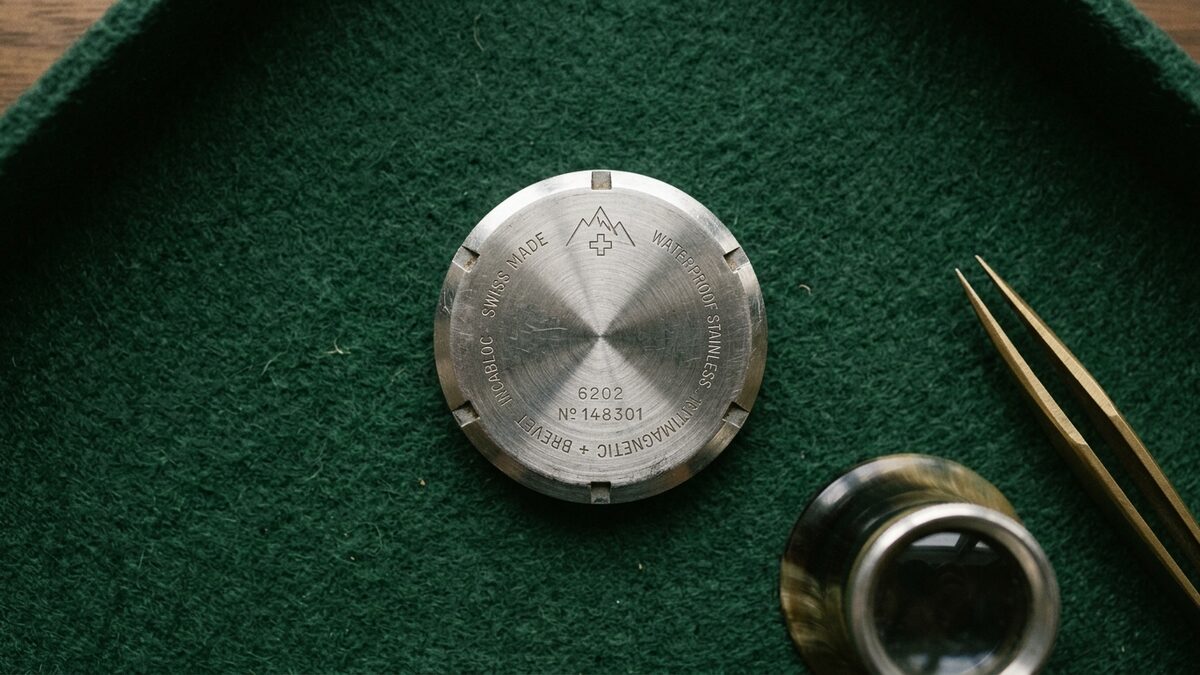
The exterior of the case back is the most public surface, and on most Swiss objects it carries the least information. A model name, a depth rating, sometimes a reference number partially repeated from the lugs, and on occasion a presentation engraving from a previous owner. Presentation engravings deserve a moment of patience. They are not damage, and on a vintage piece they can be evidence of a continuous ownership chain, which is itself a quiet form of provenance. The question is whether the engraving sits naturally in the finish, with the surrounding brushing or polishing continuing through it, or whether it appears in a freshly refinished panel that has been worked specifically to receive new text.
Reference numbers are the first identifier to confirm. On most modern Swiss objects the reference is stamped between the lugs and repeated, in part or in full, inside the case back. The two should agree. A four or five digit reference establishes the model family; suffix letters typically indicate case material, dial variant, or bracelet configuration. When a reference between the lugs reads as a steel sport model but the case back interior is stamped for a gold variant, the case has been opened from a parts watch at some point, and the rest of the package needs to justify itself before the object is taken seriously.
Serial numbers sit alongside the reference and tell a different story. A serial places the case in a production window, sometimes to the year, sometimes to a broader period of two or three years. Production records vary by manufacturer, and the ranges published in collector references are approximations rather than registry entries, but they are accurate enough to reveal obvious inconsistencies. A serial that places a case in the late 1960s paired with a movement caliber that did not enter production until the mid 1970s is not a watch with an interesting history; it is a watch that has been assembled from inventory.
Caliber Stamps, Hallmarks, and the Quiet Marks of Service
Open the case back and the movement carries its own identifiers. The caliber number is usually stamped on a bridge, often near the balance, and confirms which movement the manufacturer intended for this reference. Reference and caliber pairings are well documented for most major Swiss marques, and a mismatch is the single most common signal that a movement has been swapped, whether for service convenience or for less honest reasons. A correct caliber stamp does not guarantee originality of every component, but an incorrect one closes the question immediately.
Hallmarks and assay punches confirm metal content on precious metal cases. Swiss hallmarks have evolved over the decades, and the small punches inside a gold case back, typically a fineness mark and a national assay symbol, can be cross referenced against published charts to confirm that a case was struck in the period its reference and serial suggest. Platinum cases carry their own marks, and on older objects the absence of a hallmark where one should appear is more interesting than its presence. A clean gold case back with no fineness punch at all warrants close attention; a recase or a non original back is the most common explanation.
Service marks are the engravings most buyers overlook, and they are often the most informative. When a Swiss watchmaker performs a service, particularly at a manufacturer service center or an authorized workshop, it is common practice to scratch a small date code or service identifier inside the case back. These marks accumulate over decades and form a rough service history written into the metal itself. A case back interior with three or four service marks spaced across twenty years tells you the object has been maintained at intervals consistent with normal use. A case back with no service marks at all on a piece old enough to need them, paired with a movement that runs perfectly and looks immaculate, suggests either a very recent full service that erased prior marks or, more often, that the case back is not original to the movement.
The combinations that should prompt closer inspection are usually subtle. A reference and serial that agree, a caliber stamp that matches the reference, hallmarks that agree with the production period, and service marks that form a coherent timeline together describe an object whose history can be read continuously. When one of those elements is missing or contradicts the others, the piece is not necessarily compromised, but the seller should be able to explain the discrepancy, and the price should reflect the explanation. A redial, a service replacement dial, a recased movement, or a non original case back are all legitimate states for a vintage object to occupy, provided they are disclosed and priced accordingly. The point of reading the case back carefully is not to disqualify pieces with intervention history; it is to ensure that the intervention history is known before the purchase, rather than discovered afterward.