
Bracelet Stretch and End-Link Fit: What to Inspect on a Pre-Owned Sports Watch
A pre-owned sports watch is usually inspected from the dial outward. The case gets the loupe, the dial gets the photographs, the movement gets the service paperwork. The bracelet, somehow, gets a glance. And yet the bracelet carries more of the watch's history than any other component, because it has been touched, flexed, and stretched every day the watch was worn.
Hold a bracelet vertically by the clasp and let the head hang. A new or lightly worn bracelet remains compact. Each link sits flush against the next, the chain forming a continuous, slightly weighted ribbon. A stretched bracelet does the opposite. The links separate visibly under their own weight, daylight passes between the pin holes, and the head pulls down with a hinged, droopy character. This is the single fastest diagnostic in any pre-owned inspection, and it costs nothing to perform.
Stretch is not really stretch in the metal sense. The links themselves have not elongated. What has worn are the pin holes, the bushings if present, and the surfaces of the pins. Decades of micro-articulation, magnified by perspiration and grit, ream the holes outward. The result is play. A bracelet rated at, say, 13 grams per link at the factory still weighs 13 grams; it simply hangs differently because each junction has slack. The distinction matters because the condition is mechanical, not metallurgical, and no amount of polishing or ultrasonic cleaning can undo it.
A second test refines the first. Pinch two adjacent links between thumb and forefinger and rotate them. New links rotate against a small, even resistance and snap back when released. Worn links rotate freely, sometimes with an audible click, and often do not return to a neutral angle. Where this play is concentrated tells a story. Heavy play in the first three or four links from the clasp suggests an owner who flexed the bracelet repeatedly to size it. Play distributed evenly across the entire chain suggests honest, heavy daily wear over many years.
Reading the lug interface and end-link gaps
The end-link is where bracelet meets case. On well-engineered sports watches it sits with such precision that the seam reads as a single, continuous shape. On a worn or poorly fitted example, three things go wrong, and a careful eye separates them.
The first is gap symmetry. With the watch lying flat, examine the join from above. The two seams between case and end-link should mirror each other. A bracelet that has been removed and reseated many times, or that has been swapped between similar references, often shows asymmetric gaps. One side might read tight, the other shows a hair of light. This is rarely catastrophic, but it is a signal that the watch has been apart. Confirm by checking the underside of the end-link for tool marks and pry scratches that fresh removal tends to leave.
The second is vertical lift. Press gently on the end-link near the lug tip. It should not rock or click against the case. Lift here means either a fatigued spring bar, a non-original end-link, or a case with worn lug holes. Worn lug holes are serious; they affect every future bracelet and strap that watch will ever wear.
The third is what the trade calls cosmetic creep. Years of bracelet articulation cause the end-link to abrade the case where they touch. Look for a soft brushing line on the underside of the lug horn, sometimes a faint shadow on the case flank. A small amount is normal. Pronounced creep, especially on a watch otherwise presented as low-wear, is a contradiction worth questioning.
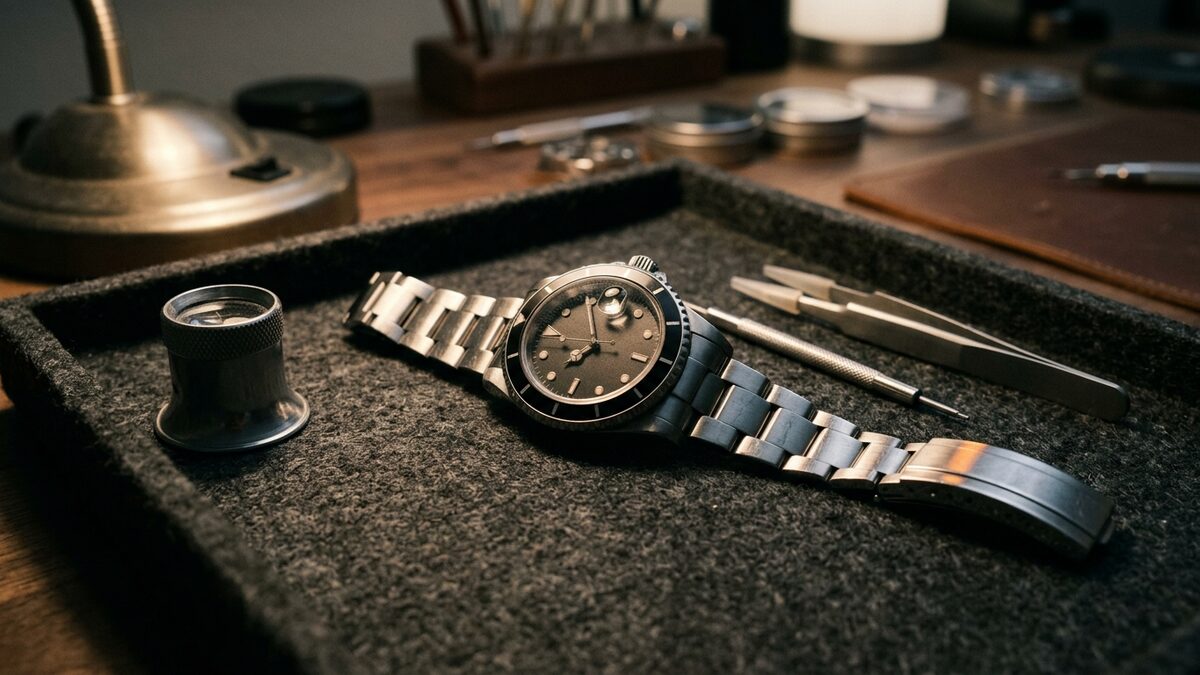
A scene worth picturing: a watch laid on a felt tray under a desk lamp, the inspector tilting the case so the lug interface catches light from a low angle. Wear that hides under straight-on inspection becomes obvious under raking light. This single technique resolves more end-link questions than loupe magnification ever will.
Clasp condition and what a buyer can actually correct
The clasp is the bracelet's third major inspection point and often its weakest. Two distinct issues live here. The first is mechanical security. Open and close the clasp ten times. It should engage with consistent pressure and release through a deliberate motion. A clasp that snaps shut too easily, or that requires a wiggle to close fully, has worn locking surfaces and may open in normal wear. The cost of recovering a fallen watch usually exceeds the cost of a replacement clasp by a wide margin.
The second is cosmetic. Clasps live face-down against desks, car interiors, and door frames. They take scratches the case never sees. Most buyers accept this, but the question to ask is whether the wear is honest or whether the clasp has been polished. A polished clasp on an otherwise factory-finished bracelet creates a tonal mismatch the eye catches immediately, even if the brain takes a moment to name it.
What is correctable and what is not divides the inspection into useful categories. Stretched bracelet links are not correctable without replacement; service centers no longer rebush most production bracelets, and a full bracelet replacement on a current sports reference can run well into four figures. Worn lug holes are not correctable in any meaningful sense without case work most owners will not authorize. Polished clasps and end-links can sometimes be refinished to match, but the work is specialist and the cost adds up quickly. Spring bars are trivial to replace and should never weigh in a buying decision. Even drilled-lug references that require a specific bar length are well-served by aftermarket suppliers at modest cost.
The practical takeaway from a careful bracelet inspection is rarely a single number. It is a judgment about how the watch was lived with, whether the seller's narrative matches the metal, and which post-purchase costs are real versus theoretical. A bracelet that hangs heavy, sits flush at the lugs, and clicks securely at the clasp is telling the truth. One that disagrees with itself is worth a longer conversation, a sharper price, or a quiet walk away. The decision is rarely about whether to buy. It is about what the bracelet is genuinely worth after honest reckoning.