
Bezel Inserts: Fade, Swaps and Originality
A bezel insert is the most exposed small part on a dive-style watch, and the one most often changed. Read it carefully and it tells you how the watch has lived; it also shows you where to ask further questions.
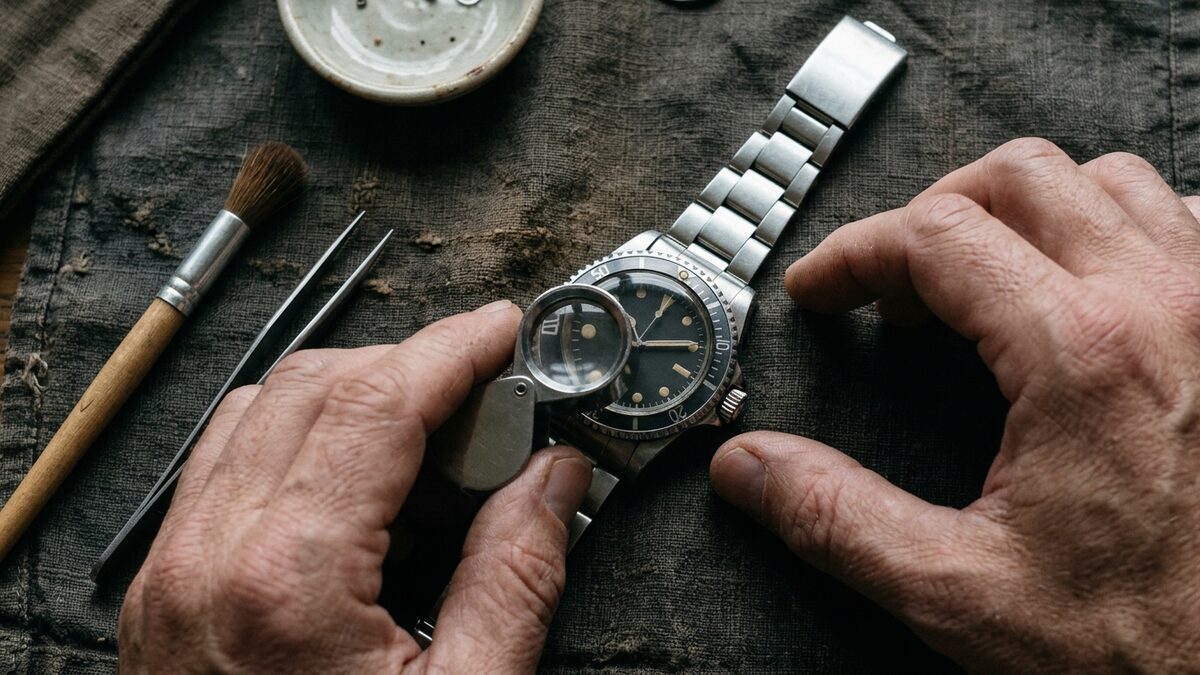
The insert is the ring seated in the bezel that carries the minute scale and the pip at twelve. It faces outward, catches light, and meets every desk edge and door frame, so it tends to age before anything else on a pre-owned watch. It is also the part collectors most like to change. One parts guide calls bezels and bezel inserts popular modifications on Seiko dive watches, and describes ceramic as hard-wearing with a smooth texture. Put those together and a single watch can carry an original insert, a period replacement, or a later swap.
Start with fade, because it is the easiest thing to misread. Honest fade is consistent. The color shifts across the whole ring, the numerals soften together, and the change matches the age of the objects around it: the dial, the hands, the case edges, the strap or bracelet. Ask one question: does the insert look as old as the rest of the watch? An insert that looks fresh beside a tired dial deserves a second look. An insert that looks far more worn than a lightly used case deserves one too. Material matters here, so ask what the insert is made of and what that reference normally carries.
Then look for the signs of a replacement. Work through these with the bezel set at zero, and use a loupe if you have one:
- Pip alignment. The pip should sit squarely over the twelve o'clock marker on the dial, and each click should land the numerals centered on the case. A pip that sits a fraction off, or a bezel that never quite lines up, suggests an insert that was seated imperfectly or does not match.
- Font and numeral shape. Compare the stroke weight, the spacing, and the shape of the numerals and tick marks with a known-good photo of the same reference. A replacement often differs in small ways: a heavier stroke, a different 2 or 5, uneven gaps between ticks.
- Seating at the edge. Run a fingertip around the junction of insert and bezel. A gap, a lifted edge, or a visible line of adhesive suggests the insert has been out before.
- Luminous pip condition. Check the pip in dim light and under the loupe. A bright, crisp pip beside dull lume on the dial and hands may be new; a pip that is cracked, pitted, or missing is worth asking about too. Glow differences alone prove nothing, since lume ages differently from part to part, so treat this as one clue among several.
- Bezel action. Count the clicks and feel the resistance, and note any play. This speaks to the bezel mechanism more than the insert, but the two are often disturbed together.
None of this makes a swapped insert a verdict. A replacement can be a sensible repair after a cracked or heavily worn original, and plenty of owners choose one deliberately. What a swap tells you is narrow: someone has worked on the cosmetic side of the watch. That raises sensible follow-up questions. Was the original kept? Who fitted the new one? Were other parts changed at the same time, such as the bezel itself, the crystal, or the hands? A swapped insert says nothing about the movement, and it does not prove that other parts are replaced. It simply means originality has to be confirmed part by part rather than assumed.
The issue is disclosure more than the swap itself. A seller who states that the insert is a replacement, shows it clearly in the photos, and prices the watch with that in mind is giving you what you need to decide. A listing that calls everything original while the pip sits crooked is a different matter. Where a watch is described as all original, ask for close photos of the insert at zero and in low light, and ask for the service history if one exists.
Cosmetic parts are also a separate question from mechanical ones. The warranty described on this site covers movement defects, parts and labor for watches sold through authorized dealer partners, for two years from the purchase date. Whether a given cosmetic part falls inside that cover is something to check on the warranty page, in the Not Covered section, or with warranty support before you buy.
A short routine keeps the assessment honest. Compare the insert's age with the watch's age. Check the pip against twelve. Compare the numerals with a reference photo. Look at the seating. Then weigh what you find against what the seller has told you. A pre-owned watch with a clearly disclosed replacement insert can be a fair purchase; the same watch with an undisclosed one calls for a harder conversation.