
Best Entry Level Luxury Swiss Watch to Buy
The best entry level luxury Swiss watch to buy is one with a movement a watchmaker can service, finishing that holds up under a loupe, and a pre-owned market that will take it back. The name on the dial comes after those three.
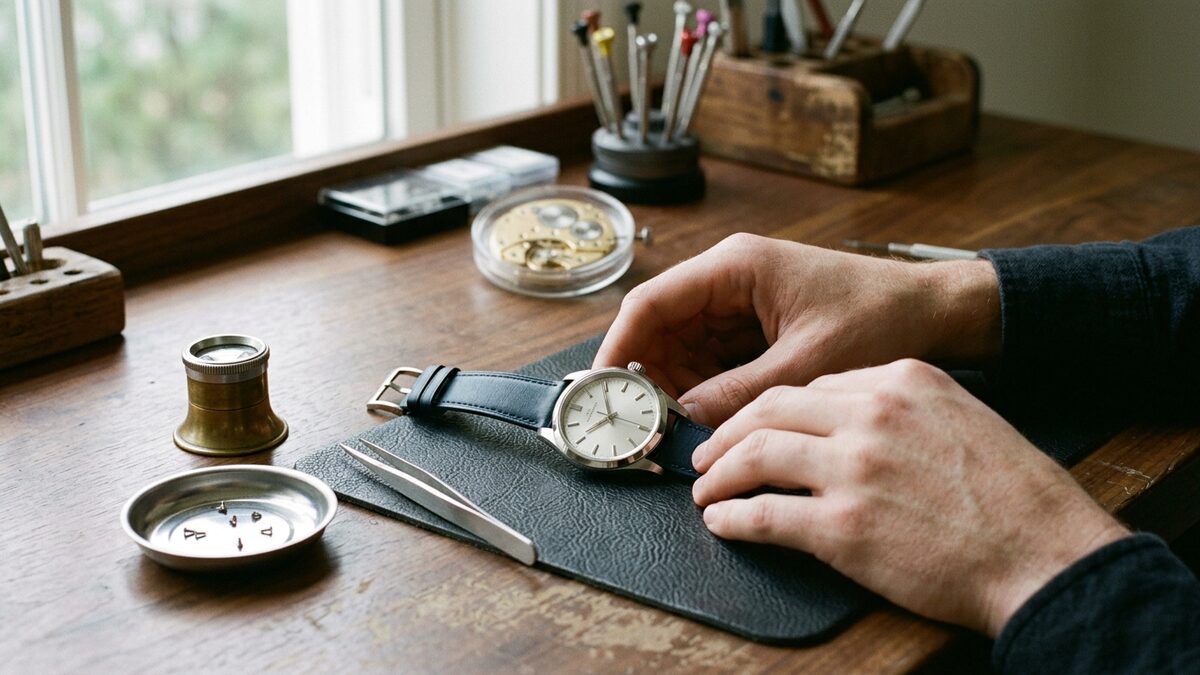
Start with what the phrase means. Entry level in Swiss luxury is a rung on a ladder, not a quality grade. It describes the lowest position among makers whose watches are built, finished, and supported to a luxury standard. A watch at that rung should not feel like a compromise in the places that matter. We leave price figures out here on purpose, since they shift with the market and with condition; the criteria below hold regardless of the number on the tag.
The movement comes first. A movement is either in-house, meaning the maker designs and builds the caliber, or it starts as an ebauche, a base movement from a specialist supplier that the watchmaker then finishes, regulates, and fits to the case. Neither route is automatically better. What a first buyer needs is a caliber with a name, a documented specification, and a clear path to repair. A respected ebauche base can serve that purpose well, because independent watchmakers tend to know it. An in-house caliber can serve it equally well when the maker supports it with parts and a service network. The weaker position is a movement nobody can name or nobody outside the factory will touch.
Serviceability is the quiet test. Any mechanical watch needs periodic servicing, so the useful question is who will do it. Before you buy, ask three things: does the maker offer service, can an independent watchmaker work on the caliber, and is there a service history for the specific watch you are considering. A watch with an answer to all three is a sound first step. A watch with an answer to none is an object you may only be able to admire.
Coverage matters here too. MyEssentialSwiss states that its warranty on pre-owned watches bought through authorized dealer partners runs 2 years from the date of purchase and covers movement defects, parts, and labor. Whatever warranty comes with the watch you choose, read the full terms, confirm who stands behind it, and learn what the process is for filing a claim.
Honest finishing is visible. You do not need expert eyes to judge it, only a loupe or a phone camera in good light. Look at the following:
- Case edges: bevels should be even and crisp, with no soft or rounded transitions where polished meets brushed surfaces.
- Dial: printing should be sharp at the edges, applied markers should sit level and line up with the minute track, and the date window should be cleanly cut.
- Hands: they should align at twelve and sit parallel to the dial without touching it or the crystal.
- Bracelet or strap: end links should sit tight to the case, and the clasp should close with a firm, even action.
- Movement, if visible: look for consistent surface finishing and tidy screws, not decoration applied only where it can be seen.
Finishing at this rung will not match what sits several rungs higher, and it should not be asked to. Honest means the level of finish is consistent and nothing is disguised. A plain dial executed cleanly beats a busy dial executed carelessly.
Pre-owned liquidity is part of the design. A watch you can sell easily is a lower-risk first purchase, because a first buyer's taste often changes. In general, a model in steady production with a recognizable face is easier to place than a one-off colorway or a heavily complicated piece that only a narrow group of collectors wants. Pre-owned buying also lets you compare real examples side by side, with the condition, box, papers, and service records in front of you rather than in a brochure. Complete documentation helps at purchase and again at resale.
What this points toward. Applying those criteria, the strongest first choice is usually a simple three-hand watch with an automatic movement, a steel case, a legible dial, and a sapphire crystal. Fewer complications mean fewer things to service. A plain layout wears in more settings. And it is a format many makers offer, which gives you more examples to compare.
Try it on before deciding, if you can. Case diameter, lug length, and thickness decide whether a watch sits well on your wrist, and a spec sheet only tells part of the story. A watch that is worn often will be serviced, enjoyed, and eventually passed on in good condition; one that stays in a drawer because it sits wrong does none of that.
So the answer to which is the best entry level luxury Swiss watch to buy is a short checklist rather than a single reference: a named, serviceable movement; finishing that holds up under magnification; a documented path for service and warranty; and a design that other buyers will recognize when it is time to sell. Find a watch that meets all four, then choose the one you will want to wear.